Minute Taker - The Oblivion
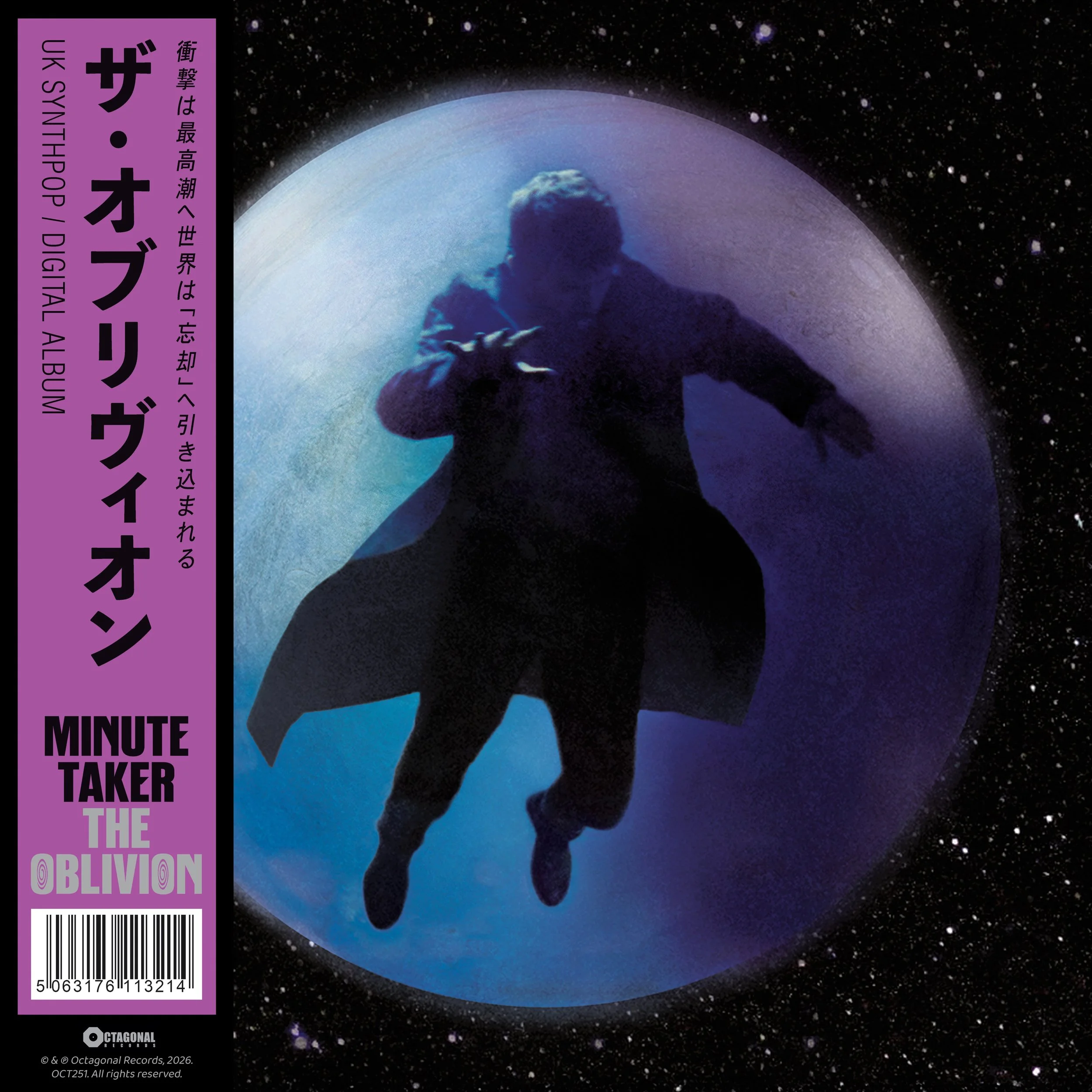
Review by Karl Magi
Overall Album Impressions
Minute Taker's “The Oblivion” exudes the artist's inimitable mixture of emotional depth, vocal beauty and atmospheric musical backing to paint images of love, loss and the way in which we live in the world. A melancholy gentleness, tinged by shadows, permeates the album and draws me into its world with conviction and undeniable vulnerability.
Central to the power of “The Oblivion,” Minute Taker's voice is finely tuned to express the complexity and extent of how our lives evolve in relation to our emotions, capturing the yearning and poignant memories that define a lifetime. His tones are unique and create a piercing feeling in each interpretation of the lyrics, driving home the mixture of hope and hurt that moves through the album.
Each song is a portrait of emotion in raw form, reaching out to ensnare me with the relatability and clarity of the images delivered. I go on my own emotional voyage as the artist carries me along with his experiences. There's an insightful quality to the words that I find deeply appealing, as the explorations delve into all of the ways in which the world brings us joy and hurts us simultaneously.
An atmosphere of enigmatic tenderness fills “The Oblivion,” dripping from the levitating notes and swirling outward from instruments that effectively bring together imagery and expression to support the vocal performances and lyrics. I'm galvanized by the strength and undeniable expression in the music, feeling it slide around me and carry me off into Minute Taker's world once again.
My Favourite Articles Analyzed
“Surrender to the Night” comes alive as a rapidly accelerating rhythm moves beneath a disembodied voiceover. Angular bass shifts below Minute Taker’s ethereal vocals as they flow through the music like velvet.
Distant sounds hover while a synth luminesces like morning’s edge and rebounding underpinnings press forward. His voice remains gentle but insistent, gathering strength before the chorus climbs with passionate ferocity. In the background, burnished synth glistens as the rhythm continues to shape the music.
Another voiceover drifts from afar while fragile notes trace graceful tendrils and wordless female vocals add haunting emotion. The way Minute Taker expresses himself is full of heart and soul, drawing me completely into the song.
Once again the music bursts with fervour as the chorus rings out. Toward the end, bells shimmer with iridescence while the hard-hitting low end keeps charging forward. A saxophone leaps into the music with burning effulgence as a final voiceover carries the song into its close.
Declaring, “I surrender every ounce of control, the world is mine tonight, I’m drunk on letting go,” the narrator describes himself as a punk and a fighter giving himself to the night. “Shame I hardly recognize the one I am by day, I’m like some circus lion locked up in a cage.”
Tonight he plans to drown his self-consciousness in wine. “I surrender to the night, blood is running through my hands.” He feels drawn toward adventure, craving danger. “I’ve been dragged in, beside myself I’m floating.”
As the song ends, he proclaims, “Sparks, the city lights are beacons in the dark and my car has run on empty far too long. I am invincible out here, out of my mind. I surrender to the night.”
A shadowy surge of sharp notes, entangled with the hint of ominous feeling, moves “Satellite” into existence with darkness rising above the encircling patterns. In the dense notes, the drums burst. Hollow, spectral sounds encapsulate disconnection and feelings of bereft emotion as Minute Taker holds me with his mixture of emptiness and defiance.
The continually hypnotizing note patterns intermingle as the guitar echoes with ghostly discomfort and Minute Taker's dreaming vocals float in a misty line above the rushing drums and intermingled synth, creating illuminating dynamism. Rough guitar tears into the music as the song evolves, moving through emotional complexity.
As our narrator says, "I won't be your satellite, orbiting you day and night," he wants to be allowed to wander through space on his own. He points out that he has journeyed much too far and, "A captured planet I am not." He can't always be around and, "Your gravity can't hold me down, I'd rather be alone."
"You try your best to capture me, but I've got strength you've never seen," and our storyteller knows that the other person would keep him locked into their tides. As he concludes by saying, "Control your waves, I'd rather not."
“Losing Self-Control” commences with tenuous notes trailing into a softly hissing background, full of billowing sensations. Reverberating drums and heavy bass create a rich heartbeat and Minute Taker’s silken voice mingles with string-like notes that vibrate in angular motion.
The vocal melody is tentative and aching as slicing notes ring out above muscled drums. As Minute Taker’s breathily tender performance expresses the words, he permeates me with compelling emotion. A steadily driving underlayer moves with darkly intertwining synth while a misty blue background descends.
The vocals move with reverent delicacy as they unfold. Minute Taker’s voice has a subtle gruffness that adds to the power of the music. A low, bell-like sound trembles and the hushed vocals sail past, while shadow-laden notes vibrate with metallic energy, contrasting with Minute Taker’s vulnerable performance. As massive bass rumbles, the song drifts to an end.
In life, people fall into line and don’t feel much of anything, “buried alive for fear of what you’ll become.” The narrator adds that it makes you want to die when “the highs turn to lows,” but you learn to survive “the devils that you’ve known by using self-control.”
“But I feel it now, I’m not afraid to go there tonight when we’re alone,” as our storyteller becomes aware that he is losing self-control. He can feel chaos overtaking his life as he finds himself alone with the song’s subject, once again losing control.
As the narrator falls out of line, he says, “tonight I’m a mess, out of my mind” and as he finds himself in the song subject’s bed, he’s “coming back to life.” He adds that all of the ups and downs are worth it with the other person and concludes, “I’m exposed, I’m losing self-control, all I know is I’m losing my grip.”
Echoes spill out into space as a gruffly cutting percussive sound moves with unsettling sensations to start “Jupiter Sings” on its midnight journey, with a rebounding rhythm and hard-edged notes moving into an energetically flying melodic pattern. As a twisting sonic pattern moves with drifting tones that wander in a lonely motion, it evokes long drives through empty city streets.
Minute Taker’s vocals have a ghostly distortion and carry me with the hypnotic patterns that permeate each element, interweaving to create mesmerizing shapes. Delicate tones hover, creating feelings of freedom and escape above the endlessly undulating notes, while the almost chanted vocals add to the mystical feeling.
In his loneliness at night, Jupiter sings through our storyteller's car radio. He adds, "Sing, Jupiter, take me into your endless void. All my troubles down here on Earth are lost in the infinite when I hear your voice."
“The Oblivion” starts with portentous shadows gathering as pools of tentative notes above vibrate with aching emotion and the drums propel broken lines. A guitar-like synth strums with darkness before Minute Taker seizes the words with conviction and his delicately spectral performance and the guitar chords add contrasting radiance.
The percussion shapes Minute Taker’s performance as it fills with wanting and hunger needing to be fed. Piano dances with a delicate touch that balances with the heavier darkness behind it, while Minute Taker captures all of the chaos and loss in his lyrics. Air flows and the melodic pattern sings out with a mixture of hurt and sharp edges, while the chaotic nature of reality reflects in the vocals. The piano touches with feathery smoothness that skims above the brokenhearted vocals and the song closes.
"Always we head into the night, blow away one piece at a time till we're gone," and the narrator and the song's subject love losing their minds, but "these days I don't recognize who we are." The taste of blood isn't enough for them, so "we go out hunting for more," which frees everyone and they "prepare to launch into oblivion, we blow apart."
"Never felt so close to divine," because the storyteller feels that "instead of being trapped in our minds we escape." He's never felt so alive before, but he's "scared that we won't survive in this place." Everything is too much for him and he's had enough as he adds, "I try but as fast as I run, it hits full force," and the world is thrown into oblivion.
To conclude, the narrator says, "In the light of morning, in a cloud of dust, I'm not sure if we're still really us."
Whispering gently, minute textures speak as trickling tones give a starry-sky opening to “Sleep-In Sundays.” As the vocals gain full force and the bass adds lusciousness and density, Minute Taker brings his words to life with wistful memory reflected through his vibrant tones.
Percussive pulsation continues to move as the vocals fly with dreams from the past while the sharp edges of the bass break and the song invokes all of the remembrance of a wonderful relationship now lost to time. Sunlit notes burst out like afternoon clouds clearing and the underpinnings provide heavy guidance in contrast to the elevated synth that captures feelings of past happiness tinged with the regret of losing that past.
The foundation cruises as Minute Taker’s spoken-word segment deepens the emotional power of the music and a saxophone rips out with ardent feeling. Minute Taker mingles his strong vocals with it to pull the listener further into the song before it ends.
At times the past still feels present and alive for our storyteller and he says, "I could swear you're right there, laughing by my side." He admits that he talks to the other person sometimes, knowing exactly what they'd say. He goes on to point out that "you were never scared of making mistakes" and harks back to the past days when "the sleazy bars we would go to, on the dance floors we'd go wild." However, he confesses that the times he misses the most are "when I woke up by your side."
The narrator says that he misses sleep-in Sundays, when they laughed until they cried and "all those dreams of what we'd be, when we had so much time." He has come to the understanding that nothing is permanent but says that the other person "had too much spirit to just slip away," so he believes that "you're out there, somewhere in range." When everything went wrong, he says the other person could make it right and "we'd dance until the dawn and I would wake up by your side."
"Oh and the records play, oh, but it's not the same," so he reminds himself on waking that he needs to make the most of every day because "time is precious." He adds that the other person taught him that lesson and he concludes, "Now I'm dreaming for the both of us."
"Into the Dark" begins with descending notes that are cut by nervous tones, creating a feeling of anticipation and nervousness before a gleaming synth and thick electric bass lock into a strumming groove with guiding drum beats. Softness and aching feelings permeate Minute Taker's affecting vocals, delivering their message of a world riven and full of challenge.
As a piano rises in the distance with a feeling of levitating ease, the harmonized vocals capture the complex emotion within the words. The chorus has an addictive, poppy liveliness to it despite the sensations of shadow within the lyrics. All of the intensely affecting power within Minute Taker's voice catches hold of me and propels its message with conviction and irresistible sensations.
The organic element of the strumming acoustic guitar balances with the glowing tones that flicker and fade behind it while the vocals cry out in an engaging rush. As the piano shines, the lyrics mingle challenge and acceptance as the twisting sounds shift before the song ends on a more upbeat feeling.
"If you're waiting for the veil to fall, be sure the darkness is inside of us," and stars that burnt out eons ago are still sparkling around us. Our narrator speaks of wars being fought to keep us safe while "leaders preaching freedoms dominate," but we are all in a cave watching shadows flickering "as the world circles the fire."
The storyteller and the song's subject know that they aren't on their own and they'll fall together into the darkness. "You and I know the way it's gonna go, together we will fall into the dark." As we twist through time, "we live in fear of one day being nothing," as the stars above glow with enough light to let us "find ourselves in darkness."
In conclusion, our narrator points out that "those who claim to know the truth are either lying or deluded, praying to their hollow gods for happy ever afters as they slaughter for their cause."
Above a colossal tide of notes, "The Highway" starts with Minute Taker's voice gasping and desperate, ragged and full of nerves with a slightly muffled sound before the full vocals flower with expression and airy softness as the percussion batters. A repeating synth figure spins out while Minute Taker catches hold of the mixture of struggle and growing confidence.
All of the layers of whispers and floating sensations capture me with their impermanence and feeling of radical acceptance before keyboard notes cast moonlight. All of the trembling feeling pours from the vocals as rushing sounds haunt the music, with the giant rhythm colliding with the echoing vocal performance before the music comes to an end.
"If you're waiting for the veil to fall, be sure the darkness is inside of us," and stars that burnt out eons ago are still sparkling around us. Our narrator speaks of wars being fought to keep us safe while "leaders preaching freedoms dominate," but we are all in a cave watching shadows flickering "as the world circles the fire."
The storyteller and the song's subject know that they aren't on their own and they'll fall together into the darkness. "You and I know the way it's gonna go, together we will fall into the dark." As we twist through time, "we live in fear of one day being nothing," as the stars above glow with enough light to let us "find ourselves in darkness."
In conclusion, our narrator points out that "those who claim to know the truth are either lying or deluded, praying to their hollow gods for happy ever afters as they slaughter for their cause."
As the storyteller runs almost faster than his legs can carry him, his white suit is "torn and bloodied," and he realizes he hasn't ever felt so scared or so alive before. After having been lost in the darkness, he now has "the light in my eyes." He finds himself running wild "across the highway tonight" as trucks rush by and "headlights hit my swollen eyes."
"My old life flashes by, all those secret nights, candlelight," as his split lips never grew tired of "chanting for strength, to survive, to leave it all behind." The neon light from a hotel sign fills his eyes as he says, "If only one can survive the highway tonight," while he chants part of a Buddhist sutra that speaks of a life lived with earnest purpose and steady effort that can triumph over adversity and lead to lasting fulfillment.
"I finally make it across to the other side, stumbling into the marshy wasteland," as his heartbeat slams in his ears and "the thought of what I've done brings me to my knees." Once he is kneeling, he sees "rising from the dirt the most beautiful lotus flower of purest white." He concludes, "Tomorrow I start my new life, on the 4th of July I'll leave it all behind."
"Pour That Gasoline" combines the crackle of flames with unaccompanied vocals that resonate with warmth and vulnerable emotion, revealing Minute Taker's feelings before a distinctly reggae-like groove shimmies into being with a twisted melodic line that snakes through the music with sensual sensations. Minute Taker has a unique depth and compelling energy that matches the varied percussion, groovy bass and addictive reggae pulse of the song.
The way in which the vocals carry the emotion with the steadily flowing rhythm pushes them deeply into my brain, permeating me with feeling. Computerized and sharp-edged, the vocals move above the locked-in reggae heartbeat that is addictive and entertaining. All of the trumpeting dynamism of the synth line has an undeniably cool feel, sailing out with catchy sensations. The channeling of the '80s passion for reggae music stands out as a piano creates soothing vibes while the backbeat shifts.
After a brief pause, the chorus shivers with the depth of feeling within it and the low-end beat drives forward. As the razor-edged, technological-sounding vocal line locks into the continual bopping pulse below it, the trumpeting tones transmit the melody with a tranquil cool that is undeniable before the song ends.
"When you're in love, it's not enough 'til you've lost it," while you pour gasoline on the fire and run.
The narrator reminds the audience that when you're in love, you tend to give yourself over too fully to emotion. Pointing out that you ensure that all of the "walls and carpets and the king-size bed he took so long to find" are soaked with gasoline before laying a trail down the hallway and throwing a match on it as "the reds and blues flicker in your eyes."
"You're gaining back control as the flames are taking hold," and our storyteller adds that you got lost in the situation for a while. Now smoke fills the sky and, "As you run into the night, a photo of you both somewhere inside is withering to white." After a moment, you stop dead as memories of how "it feels to hear him cry" fill your mind, but you can't go back. You made sure to leave everything behind because it's "the only way to survive."
As the narrator speaks about "all the possibilities of the freedoms you gave up for him for a while," they give over to regret for "the cruelty that you let take hold of you again like some scared child, but you bury it inside."
Floating with melancholy serenity, tones drift to evoke a midnight mood and “Alone” fills with moonlit glow and thoughtful hush as a saxophone slides with sensuality and smooth passion, creating the sensation of a smoky bar as threatening sounds briefly descend. A rushing, undulating underlying rhythm moves with a howling guitar.
Minute Taker fills his voice with mystery and haunting tension while the piano trickles in a line of bereft, mournful notes above the loping rhythm. Enchanting and enigmatic, Minute Taker's performance grasps me, pulling me into his world. An atmosphere of floating, spectral sensations contrasts with the ferocious vocal energy. Crushing sounds growl and the piano brushes like tender fingers while Minute Taker contributes ghostly delicacy, tremulous and full of intensity and the beat locks into an underlying pulse as the vocals move with misty feelings before silence falls.
In a landscape of moonlit serenity, "Raindrops drift in glistening sheets," and the narrator feels as if he could be the only person left alive, "the last survivor wandering these streets." He adds that people's deafening sounds get him down, so he waits them out, staying in the house until night falls.
"The world is my own with not a living soul," as he roams the midnight streets alone. "The moonlight leads me home, back to the me I know," as he feels that being alone is what he needs. He continues, "It's like a dream, the misty streets unfold before me," as other worlds rise in the "midnight haze."
To conclude, the narrator says, "I could be my childhood self or perhaps the old me; out here I'm not tied to time and space."
Conclusion
“The Oblivion” takes unadulterated, earnest emotion and delivers it with musical fascination and lyrical beauty, anchored by Minute Taker's unmistakable and finely honed voice. I am enamoured of the journey that unfolds through the music and transports me into a realm of pure feeling.