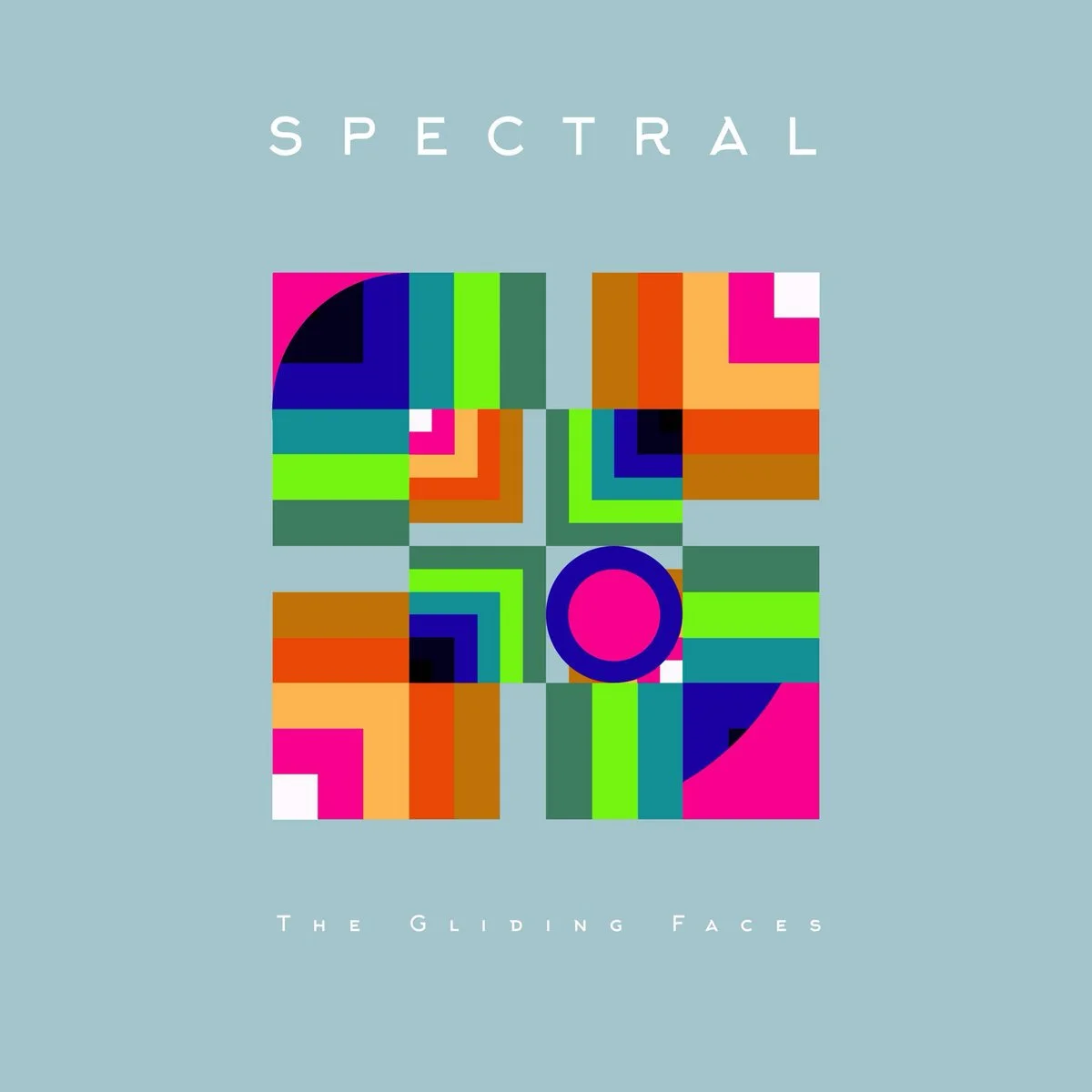
The Gliding Faces - Spectral
Review by Karl Magi
Overall Album Impressions
The Gliding Faces’ “Spectral” takes an emotional voyage through the lens of the colour spectrum. Each song, inspired by a colour, is a means of exploring the interwoven emotions which embody humanity. Captured by Max Herring’s uniquely engaging voice and filled with intriguing and expressive sounds by the producer, the lyrics are reflections of everything from love to loss, through heartbreak and exaltation. Each track’s inspiration transfers to me as I listen and I am carried away by the feelings that rise within me as I explore the album.
Max Herring possesses one of the more distinctive and interesting vocal styles in the synth-pop world. He has a sound that seems to capture all of the intense sensations woven into the lyrics. Deep feeling is conveyed in each word and the way he sounds carries emotional resonance. Given the powerful expression within each song, his vocals seize me, convincing me that he feels each part intensely.
Lyrically speaking, all of the songs and words on “Spectral” are created on the basis of different colours and how they might reflect different parts of one’s life. The way in which the spectrum is worked into the songs is clever and allows them to expand out from that starting point. Many of the songs felt at home for me and captured emotions that I have also experienced, drawing me further into the music as they unfold around me.
A clean and stripped-down production allows the singing and lyrical content on “Spectral” to shine while still adding depth and shape. Daniel Graham and Max Herring’s production has an interwoven palette of ear-catching sounds and melodies that reach out to engage the listener. Each song has a unique sound and a different style that nonetheless comes together in an interesting whole.
My Favourite Songs Analyzed
“Terracotta” has a tangled weight which supports disconcerting twists and flashing chords, percussion snapping as cut-crystal bells sparkle. Relentlessly heavy rhythmic oscillation gives underlying strength to sugared strings singing with tenderness. Max Herring catches damaged feelings like the touch of a warm hand. Beats surge as strings glisten, broadcasting anguished emotion.
I am engaged by and full of the song’s vocal expressions, depth growing beneath them. Strings like silk and fluttering wings move as the intensity of feeling flows. Suppressed anger moves beneath softness, ragged edges occasionally piercing the cocoon of unfolding sounds before the song ends.
Beginning with a wish that the song’s subject had been more careful at the beginning with their “terracotta heart,” our storyteller points out that “one step at a time, you're still guilty of the crime.” In a rush, everything makes complete sense and he says “trying to paint over the cracks is no defense.” In the song subject’s “terracotta soul” there are shards that are “as deep as the hole that you dug yourself into,” leaving the other person to deal with the situation on their own.
Jumbled cascades of bending tones are shot through with lambent illumination to commence “Tangerine.” Disconnection defines high tones that wriggle as an uneven foundational flow undulates, while expression flows from Max Herring’s contemplative vocals, full of clarity and dawning comprehension. Echoing energy erupts while a gem-like sheen glints off the vocals, seized with remembrance, falling in complex emotional layers.
Richly vibrating notes flicker while unsettling sounds intermingle in contrast to the velvety sweetness within Max Herring's voice. A cloud of yearning is broken by sunlit chords as glittering notes perform aerial acrobatics. Feelings of changeability and progress trade off as piano carries thoughtful sensation. As I travel with the emotion, my heart embraces the song's message before it exhales into quiet.
“Dipping my feet in a rock pool, staring past the only cloud,” the narrator thinks he’s foolish as he breaks away from the crowd. “My fingers through the olive leaves, my face reflects the sun” as he points out that his life is merely a tapestry and “my threads are finely spun.”
“This tangerine scene begins in Riomaggiore” and the tangerine dream in which he finds himself is “the best chapter of my story.” He holds a limoncello in one hand as the stars are “broken in the sea” and comes to comprehend focusing on himself.
“My body immersed in waves, my face reflects the moon” as he understands his life is just a tapestry and the current chapter is coming to a close. He concludes “this part I could never stand, as tarmac replaces sand, it’s stuffy in this taxi, thinking of home will relax me.”
“Sycamore” slips around the listener's ears in a lusciously resonant melodic pattern, transported on a deep piano-like synth. Impressions of longing and loss are woven through the notes before the lead singer delicately explores the emotional wages of missing someone. In a full-sounding burst, rhythmic direction flows as a luminous synth creates dappled sunlight and the piano trembles. Muffled beats shiver and cascade as the piano lends supporting strength.
I can detect the sensations of absence and affection within the vocals, permeating me like warm light tinged in mournful feeling. Heartbeats fill the drums as they actively leap and an interweaving ballet of vocals and piano drifts with caring and remembrance. Resonating bass slices and the lead singer encapsulates yearning and old pain before drums and bass vibrate and the track ends on shining piano tones.
Like a sycamore tree, the song's subject held on to their branches, let go of their leaves and had “your seeds under the arches, your roots under our feet.” Our storyteller feels the loudness of the other person's absence as he says, “a gust of wind and a spot of rain, seems every year we face the pain again, a low sun behind a blanket of grey cloud.”
The song's subject reached high above the narrator and he wonders how deep below him they went. He describes them like a sycamore tree standing “stoic and starkly” with their trunk “skirted in snow.” Now the other person is like a “stump in a clearing” and the narrator will never know why. He concludes, “all that I'm hearing is that it's time to let you go.”
Hollowed-out vocals mingle with sonic ripples, metallic percussion and fragile strings that exude “Cerulean” to open the track. Like tiny motes of dust lit by sunlight, the chimes mingle with the muffled vocals and splashy sounds shift. A statement of honesty and hope is illuminated by caressing tones rising from sunset strings. Pure aspiration flows from the lead singer's voice as it reaches out for something more.
Strings lustrously slip to gild the music with peace as Max Herring’s vocals touch my heart. The splashing sounds flicker as popping rhythm gives an accented staccato while the pain filters through the vocals before rising emotion carries the tune to a close with spangling chimes.
Pointing out that there's nothing more valuable than time, the narrator says that “it's about what's possible, never mind what's improbable.” All he wants is “cerulean sky,” even though he doesn't know when or why. He also wants “peace in our time” and for humanity to soar and fly.
There's a threat behind every door and our storyteller wonders if we are “all done for” or if we could achieve more. To conclude, he says, “there'll be no death-defying feats in a land of rust, ashes turn to ashes and dust to dust.”
“Orchid” shifts in ghostly waves to create an atmosphere of growing tension, highlighted by bells ringing in dramatic brightness. Tapping underlayers mingle with striking bells, the atmosphere fraught with discomfort and tension. Defiant and resolved, despite the airy touch of the vocals, Max Herring is ready for change. He engages me with his message, his voice grasping all of the emotional nettles in the lyrics.
With a ferocious luminosity, bells rise and churning tones surge behind them to increase the haunted emotion. Pulsating with unstoppable motion, foundational patterns drive while Max Herring confronts the end of the relationship with melting emotion, finally reaching a conclusion. Twisted notes slide behind an anvil ringing out while vocals paint imagery of closure and finality, the ending chorus balanced with brilliant, vaguely threatening light.
“No lies, no other loves” is what the narrator wants. He encourages the song's subject to “take off those kid gloves, release the flock of doves into the skies above.” They thought they had everything figured out with “checks checked and bills paid,” but their feelings began to dissipate. He points out that it can be tough to manage relationships and “love can be intangible.”
“I'm not an orchid, I'm not a feckless child blundering through life's maze,” so he wants the other person to stop protecting him and allow him to be wild “like an orchid needs space.” The song's subject thought they “had it rough” and our storyteller was done with the relationship. He adds, “it's time to act out tough, I'd better pack my stuff.”
To conclude, he says, “it's not as easy as going with the flow, if you love someone let them go.”
Doom-laden bass is broken by trembling tones to evoke the growing shadow in “Ash.” Contrasting light and darkness flicker and fade while open vocal tones join Max Herring’s fascinating voice. Pounding weight descends before shining luminosity pierces the cloud, a mixture of grief and acceptance within Max Herring’s shivering vocals.
A glowing synth adds lustre in contrast to the darkness within the bass. Swelling gentleness mingles with sunlight while the vocals touch my soul with a sense of forced acceptance. A reflection of complexity flows from soothing notes, touching with tentative affection, meeting the realization that cuts to the heart. A soaring burst of energy leaps from Max Herring to gleam before the throbbing rhythm ends the song.
Through air heavy with a “sulphurous gust,” anger permeates as the song's subject loses our storyteller’s trust. It hides the light in “a suffocating haze, like the ruins of Pompeii painted in greys.” He's only left with emptiness in the midst of the other person's mess. He adds, “you’ll fight my inner flame and cast off the blame.”
“We built a mountain, it's burning loud” as their demons are tamed “to stand above clouds,” and the narrator says that one day he'll figure out why the song's subject “hid another underneath the ash and rubble, the creator of this trouble.”
“Midnight” flows plaintively before pattering drums commence their guidance, as rising chords melt together with a pang. Vocals like cobwebs and broken hearts wander, carried by the lead singer’s profoundly touching voice, while drums punch with great weight. A piercing sensation of hurt and the growing weight of time slide from the vocal melody, giving voice to the loss that is so palpable.
Shuddering rhythm tracks move below the lead singer’s climbing voice as it shatters to fragments against the pain of the lyrics. A haunting pulse eerily shifts like the tendrils of a spectral being lurking in the shadow of the past before the lead singer ends the song with a broken cry.
As messages are transmitted to nobody, with nobody to receive them, the narrator waits for the song’s subject to arrive, realizing, “It’s me I’ll deceive.” As the clock’s face expands and his arteries dilate, the clock’s second hand moves slowly and “this plan will gestate.” He’s “a second away from midnight, a minute in the moonlight, an hour in the twilight,” and subjected to the other person’s spite for a day.
“If time is the enemy, then who am I to judge?” because the song’s subject’s decisions led them to where they are and he’s holding on to his grudge. The storyteller concludes, “Never mention my name again, your impatience is to blame. You’ll remember back then when we still had our flame.”
A string quartet permeates “Onyx” with melancholy and reverberant majesty, capturing damaged hearts and shadowed pasts. Beauty mingles with a bereft feeling as Max Herring’s devastated vocals move above a pounding beat that thunderously shifts. The strings call out with watercolour delicacy and raw sensation while percussion marches and the lead singer grasps me with his memories of emptiness and agony.
Computerized edges contrast with organic warmth, split by the intense feelings of desolation pouring from Max Herring’s voice. With great power and weight, low-end rhythm guides yearning strings sobbing with all of the complex feeling of the words. A growing threat moves beneath the vocals as they seize me with almost unbearable emotion before the music ends.
It wasn’t our storyteller’s choice to bear his burden from infancy. He has “fallen off the straight and narrow, leading to dependency.” Although it was a long time ago, what he did is still important. He says he did it out of love, but adds, “You never even held me, how could you be so selfish?” He continues, “I’m asking you the same, I did the best I could,” but the song’s subject is never blamed.
As the narrator sees life through “onyx eyes,” he suffers bruises before lacerations. “Wound after wound,” he survives being eradicated. He adds, “You couldn’t be this, they stole your innocence, such violent affairs.” He asks the storyteller if they remember the time they said they never wanted him. He points out, “I had to stand on my own and watch you laugh carelessly.”
After giving the song’s subject a million chances, they wasted them all. He concludes that “I’m sidestepping these dances from where lesions once sprung.”
“Snow” flows with tragic feeling and echoes with metallically vibrating percussion, permeated with sadness by the vocals and lit by glockenspiel. Tentative and full of piercing sensation, Max Herring’s voice caresses and cuts with equal feeling, capturing the emotions of loneliness and rejection. Fragile sounds capture abandonment and a search for friendship, bringing me along with that feeling. Strings drift distantly like feathery snowflakes on skin.
All of the elements compel the feeling of need and a burning desire to have companionship, the string section levitating and evoking the dream of finding friends and affection through the heartbroken vocal performance. Drums tumble downward while Max Herring continues to fill his vocals with all of the yearning moving through the lyrics. A choir and the strings come together with gentleness and pain before the music ends.
While he is “surrounded in white, my feet turn black,” the narrator abandons hope of anyone returning. He says, “I’m testing the water, going in for slaughter.” He wonders if they want him and if he’s worthy. He asks, “Did I say too much? Did I do enough?” He adds, “I’ll try again and see, I’m so lonely.”
Despite being “ignored and pushed away,” the storyteller knows he tried his best. He’s a “child in snow, soft-hearted and the oddest.” His spirit is shattered over and over, but “I’ll keep trying, even though I’m so cold.” He searched for companionship and found a friend, “but snow is blinding, this will hurt me till the end.”
Subtly shifting like a soft breeze, strings surround me in contemplative emotion as “Silver” sails into life with smooth grace. Charging drums kick in, balancing action against the vibrato of the violin before tumbling arpeggios cascade around the vocals as they dream and seek hope. Max Herring’s vocals mix aspiration, self-care and damaged feelings while the melodic pattern calls out with radiant light, flickering like the sun breaking through morning mist.
Repetitively rippling arpeggios add texture to the glowing notes, the melody leavening the lyrics with more encouraging sensations. Piano chords dynamically fly as Max Herring takes me into his emotional realm while the arpeggiating notes weave a starlit background. Snare drums snap to add crispness while the backing string section is joined by rushing beats and the vocals enfold the listener in powerful emotion before the track glides to an end.
As he looks back over his life, our storyteller sees “all the things I once wanted to be,” but he never reached those goals and lost “the threads of meaning in a tapestry we weave.” In a moonlit scene, “the silver of your tongue burns through my eyes and I know what you’ve done.” He can tell the song’s subject has been out and had fun. He adds, “I still feel that you could be the one.”
In the “silver moonlight, your silver tongue” is the silver knife which undoes them. “A silver sparkle, a silver sheen, a silver plating, the copper turning green.”
Conclusion
“Spectral” travels through a plethora of different experiences and feelings, using the lens of colour to capture different emotional states. The clarity and sharpness of the production, combined with the fascinating instrumental choices, results in an album that encourages continued listening.