
US3R - Colors

Foreword by C Z A R I N A
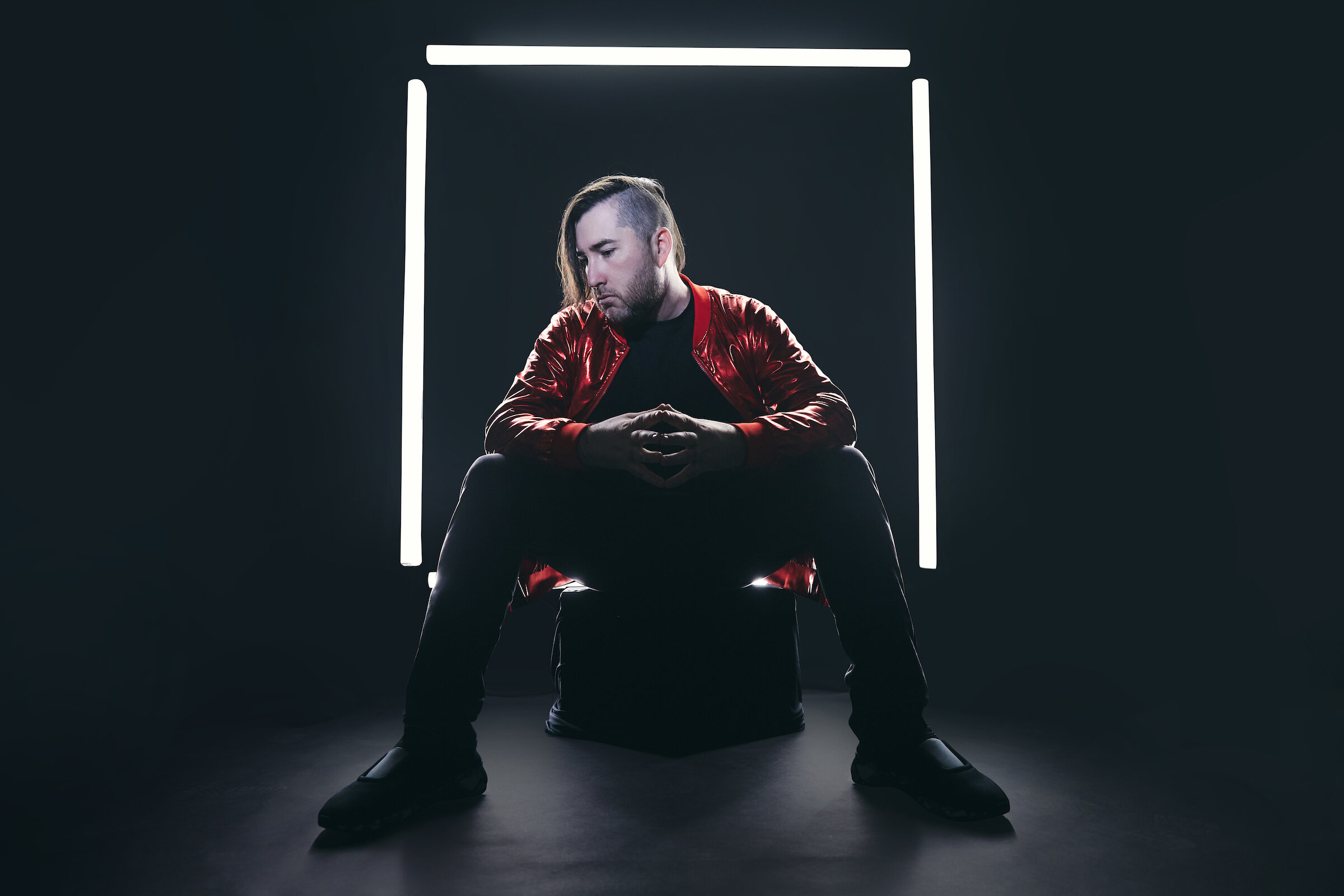
Seattle-based electronic artist, multi-instrumentalist and producer Kristian Alexander, aka US3R, has been hacking pop music by creating unconventional sounds and weaving them into dystopian lyrical themes. Described as a combination of Justice, Daft Punk, The Weeknd, Billie Eilish, and Disclosure, his music feels familiar yet counters conformities and breaks fresh grounds. He also has a striking approach to his visuals and live performances — particularly the most recent one at the Static Realms’ Synthamania festival, where US3R cloned himself several times to perform each instrument in his songs.
US3R’s recent album INFLUENCE was created as the “Black Mirror” of electronic music. The other-worldly, grungy concept album explores social commentary about modern love, acceptance, and belonging in the era of social media, where people’s worth is measured by likes and followers.
In early 2020, the INFLUENCE Tour saw US3R playing shows across North America, before the global pandemic forcefully shut down the live music industry. Ever since, musical innovator US3R has leveraged his background in tech. Recently, US3R decided to use AI technology to explore a new frontier of AI-generated music, giving “hacker pop” a whole new meaning. The result is in his latest single, “Colors” - a smooth, vibrant electro pop track that brings holographic and colorful spectrum of images to mind, leaving a sonic trail of Aurora Borealis. We asked US3R to write about this unique experience.
About ten years ago, I set off to write a piece of software that would perpetually improvise music according to a variety of input parameters. I could change the beat and tempo, the genre of the music, the backing chords and layered lead melodies. My vision for that project was to be able to generate royalty free music as a service. Back then, my toy software project seemed innocent. I had no idea what would happen in music just a few years later.
Over the last couple years, there has been an explosion in the pace of advancement in machine learning and other AI technologies. Now, apps predict our every move, ML generates the articles we read, and sophisticated predictive modeling helps us rapidly find new treatments for diseases. Naturally, the creative technologies in the world wanted to apply this technology to music. With projects like Google Magenta AI, researchers were able to generate a whole new Nirvana song by using data from past Nirvana lyrics, chords, and melodies to train the new models. The scientific and music communities were shocked and amazed by the rapid advancement of music AI.

But what will we do when AI generative music is used for less benign purposes? As we saw in 2021 with the #FreeBritney movement, we learned that teams of people are more than willing to exploit artists with their likeness, their brand, and their fan bases to create a product to sell, even when the artist themselves do not consent to it. Like something straight out of Black Mirror, I believe we are at the edge of a new horizon in music where computers are no longer just tools to produce music. Instead, we are rapidly coming to grips with a new reality where AI may be, at best, accompanying the songwriting process, and at worst, replacing the artist altogether.
I wrote Colors to plant a flag in the ground and get a conversation started about what it means to use AI in music. Specifically, in Colors, I used neural networks to generate sets of lyrics that I could use in a new song. Once those lyrics were solidified, I attempted to compose music and feelings around those lyrics. In other words, US3R was the accompanying artist, and the AI was the centerpiece. At times, the phrases used in the songs felt alien; they contained phrases and sequences of words that I would never say as a human being. But, resisting the urge to polish the lyrics too much, I embraced these weird moments as evidence of the uncanny valley in the music - weirdness that is itself a byproduct of the robot - it was something unique that the AI was bringing to the table that I could not.
KIZUNAUT

I am Oskari Lappalainen, aka KIZUNAUT, a 32-years old musician and writer for Absynth among other things which include my administrative dayjob. I started Kizunaut in 2017 as a side-project to my back-then two-man band which never really got off the ground. I have been making music since 2008 or so, starting with a solo project, moving to a band that produced a mix of industrial rock and electronica, before moving to another solo project, before moving to another attempt at a band and finally Kizunaut.
These years included a long hiatus during which I mostly focused on my studies. I graduated from the University of Helsinki in 2017 as a Master of Social Sciences, majoring in sociology, with science and technology studies and computer science as minors. I entered the academic world wanting to understand the world and humanity, and left with a sense that neither of these are truly understandable. Nevertheless, I have retained the curious and analytical attitude that led me to my academic detour. These years also gave me experience in writing, both within the courses and to several student magazines. I have utilized these skills in my later ventures.
I am a producer and a multi-instrumentalist, playing keyboards, guitar and singing. I picked up the guitar in late 2020. I had tried to learn guitar from 2011 onwards, but never found the time to do so during my studies and had convinced myself that I could not do it. But one can not escape one’s dreams and inspirations forever, and the Covid isolation had proved the perfect opportunity to learn the guitar. Picking up guitar was an extremely revitalizing experience, and I enjoy playing it tremendously and it has brought new blood to old ideas.
My discography as Kizunaut includes two albums, several singles and the Crisis 2033 EP. This Was The Future (2019) was an album which dealt with dark retrofuturism, hauntology, and a feeling of lost future, a kind of attempt at making sense of the craving for nostalgia which pervaded the cultural atmosphere. The City by the Sea (2020) was about the struggles and joys of modern urban life, an attempt at connecting my emotions of feeling disenchanted with urban life to a larger social sphere.I enjoy making music with some kind of a bigger idea or concept behind it.
My music as Kizunaut has constantly been moving towards a more rock-oriented style. I started off with pure electronic music as at the time I was really inspired by it and had grown somewhat frustrated with my attempts at making industrial rock with other people. This Was the Future incorporated singing and a style of composition that mimicked synthpop and industrial rock while using synths as stand-ins for guitars. Ever since 2021 I have included guitar in my music. I like to have a solid electronic basis in my music, but I also like to incorporate human elements to it. It keeps it from becoming too sterile and stale.
Beyond making music, I enjoy videogames, science fiction, anime, delving into the crazy creative vortex of modern net culture, learning, pondering about the mysteries of existence, reading, eating and spending time with my friends.

My new single Leave Humanity Behind deals with humanity’s dreams of achieving a kind of transcendence through technology, the old dreams of technological singularity. Or perhaps it is technology itself whispering these promises to us? Whatever the case, I find myself critical of such far-fetched dreams so reliant on a force that has proven so unreliable, so impossible to predict, and with such great externalities.
Technology has destroyed as much as it has given, and it has pushed humanity into an unprecedented dialectical spiral: technology creates problems and then creates new technology to try to solve these problems. This has given humanity never seen before advances in many sectors of life, but also irrevocably altered the global biosphere and human culture. Is it all really worth it? Is more technology upon technology really the answer?
Musically it’s inspired by synthwave, synthpop and industrial, with an ever so slight hint of shoegaze and modern electronica in its DNA. Spiraling bass arps, echoing piano, shimmering arps and gritty guitars serve as the instrumental backbone. The track features a heavy layering of instruments, building constantly upon itself much like technology constantly builds upon itself in it’s eternal forwards-going spiral.
The vocals are heavily effected by a mix of a crude autotuning software and extreme distortion: it serves as a sonic counterpart to the lyrical themes of struggling with and doubting technology; a computer program seeking to overpower the human voice. The heavily modulated lead in the chorus also utilizes the same crude autotune software in a way rarely seen. These last creative touches were inspired by Oneotrhix Point Never’s extreme vocal edits.
As for musical inspirations, in general, I draw from several different strands: the 80s pop and 90s eurodance that populated the airwaves of Finland during my childhood, metal music which I got into during the huge metal boom in Finland during early 00s, the oldschool industrial music I discovered through Laibach, which I discovered through getting into Rammstein and Fear Factory as a teen.
I am also influenced by synthwave, which I see kind of encapsulating all of these inspirations and also influences from video game music, and other forms of contemporary music. I particularly enjoy music with strong rhythms, a kind of dark passion, good hooks and depth beyond the surface. There’s such great music in almost all genres, from traditional rock to EDM, dubstep and techno, and you can hear splashes of influence from surprising genres in my music.
Individual artists that have served as major inspiration to me include Nine Inch Nails, Depeche Mode, New Order, HEALTH, Perturbator, Dan Terminus, Carpenter Brut, Irving Force, Covenant, Apoptygma Berzerk, Skinny Puppy, Haujobb, Front 242, Front Line Assembly, Haujobb, and Nitzer Ebb. The videogame composer Frank Klepacki deserves a special mention. His soundtracks for Command & Conquer and Red Alert introduced me to music that I would later understand to be influenced by 90s industrial and electronic music.

As for the future, during 2021 I have been mostly wrapping up various pieces of music from my vault that would fit to be released as singles. I have had various conflicting ideas for future albums, but there have been also a number of tracks that, while I think they are solid, just do not necessarily to fit into a larger whole. Covid has put life into a kind of pause, and I have tried my best to make use of it and releasing singles and building up connections and expanding the potential listener base have seemed like a good way to spend the time.
More concretely, I have a fun darksynth influenced thing coming in time for Halloween. After that, I have 1-2 more somber, personal pieces coming for the winter, and perhaps a small surprise for the early spring if timetables allow.
Beyond that, I have reached a solid idea for the next album. It will deal with humanity’s relationship with technology through metaphors of attraction, addiction, love, dependency and craving, treating technology as a kind of a living, breathing thing with an almost occult, invisible, but very real power. I feel like humanity’s relationship with technology has become painfully intimate and very confusing, with it shaping much of our relationships and perceptions in ways that we rarely seem to really reflect upon.
I think the dry, academic, economic, ways of talking about technology and its impact on society have failed humanity. The way people reacted sarcastically to Black Mirror which made a valiant attempt at shedding light on potential future courses is symptomatic. We are creatures of narrative, belief and myth, of social relations and personal sentiments. It’s one thing to say that computers have become detrimental to our happiness; another to sing that we are in love with the wrong things in life. I hope I can reach not only fresh musical territory but also perhaps find new ways to speak about certain things with the coming album. If nothing else, it will be a valiant, defiant exercise in being human.
For more KIZUNAUT, visit kizunaut.bandcamp.com
CODE ELEKTRO - Live At The Radar Station

Review by KIZUNAUT
CODE ELEKTRO is the synthwave project of Martin Ahm from Denmark. From 2015 onwards he has managed to build a global fanbase as well as reach critical acclaim within his home country. Stylistically, Code Elektro has leaned on the more soundtrack-inspired side of synthwave, citing the soundtracks of movies such as Blade Runner and TRON: Legacy as an inspiration. Describing his music as “Dystopian science fiction atmospheres, neon Skylines and eternal cyberpunk nights with acid rain,” Code Elektro does indeed deliver in science fiction ambience. His albums seem to have certain theming to them: 2019’s Never Mind the Solar Wind had a decidedly space-oriented sci-fi sound to it, while 2017’s Triad had a kind of asian flavor to it.
As one can surmise from the title, Live at the Radar Station is however a live album, a rarity in the synthwave genre. Gigs in themselves are a rarity in the era of Covid lockdowns, so this album is a rare creature indeed. For the performance Martin put together a live band, with a guitarist and a drummer joining him onstage. The performance was recorded in Radar, a venue in Aarhus, Denmark, giving the album its name.
Performing and recording live music is wholly an art of its own, and the team involved with this effort has succeeded well in both. The tracks are mostly quite faithful to their album counterparts and represent Code Elektro’s four-album catalogue rather evenly. The biggest difference probably lies in the addition of guitar to tracks that didn’t have it before, sometimes playing leads or more drawn-out atmospheric passages, sometimes serving in the rhythm role. The drummer brings his own human touch and adds little flourishes to the songs. All musicians involved appear to be quite the seasoned pros at performing.
The recording side of things is executed with stellar success. I can only speculate whether this was recorded from the mixer or from the hall or perhaps both, but the occasional audience noises hint at their being at least some hall recording mixed in. Whatever the case, it sounds great. The largest difference production-wise between these live recording and the album versions is mostly that there seems to be a bit more “air” in the tracks, perhaps headroom, perhaps ambient reverb from the venue in them, but I find it actually quite fitting for Code Elektro’s soundtrack-ish style.
On the visual side of things, the album cover recycles the cool, kind of biomechanical dragon head design from the Triads album. While it’s a nice design, I feel like the album would have benefited from a visual identity of its own. I was also surprised to see that only one song from the performance has a video of it uploaded as of writing this review. Perhaps there is more coming, but if not, then it feels like a bit of a wasted opportunity.
The album begins with the ethereal pads and throbbing bass lines of Wolf, an apparent fan favorite from Code Elektro. A groovy hi-hat pattern comes, the bass lines modulates into a gnarly, throaty sound, and a brief silence leads to the main body of the track, with a vocal-like lead synth casting a melody that feels like a call to an adventure. The track strips itself down, offering a variation of the main lead before moving into a buildup towards a pretty sweet guitar solo. After the solo finishes, the track moves into a section dominated by the lead melody, leading into a brief outro with guitar taking the lead role once again. A great opener and one of my favorites from the set.
N3on begins with a curious-sounding, sharp synth sequence. The synth sequence slides into the background as the song opens up, with deep synth bass, distorted rhythm guitar and thin square synth melodies serving as the backbone. There is a somewhat melancholic, fateful sound to it all, the melancholia strengthened by the moderate tempo of the song. A brief interlude featuring remote synth strings and stabs of synthetic piano leads to the main body of the track repeating, this time with an extra synth lead that evolves into a wildly squirming, heavily modulated beast. Another interlude comes in, featuring a steady bass arp and distant choir synths before moving into one last repeat of the track’s main part.
Night Train opens with a slow, steady, heavy bass arp and high-pitched shifting modulated synth melody. They are soon joined by staccato rhythm guitar and a sharp arp. Drums come in while the lead keeps on playing and the track slowly layers atmospheric elements on top of the synths, drums and guitars. An interlude featuring a synth that recalls a hybrid of an electric piano and an organ comes in, other elements giving way for this brief passage before the lead and other elements come in again. Taken from the Triads album, it shares the vaguely asian atmosphere of the album.
A sharp bass arp kicks off Never Mind the Solar Wind. A filter sweep leads to the main body of the track, and the arp is joined by rhythm guitar and drums. Hollow synth melodies, needle-sharp synth staccatos, airy choir pads and heavily modulated samples talking about an “expedition” color the track. Towards the end there is a section with a heavily modulated synth lead. The track has a very sci-fi, kind of mysterious sound to it all.
Gnarly, swooshing synths, rhythm guitars, a toothy PWM bass line and a drum buildup kick off Driving On the Moon. The track is quite atmospheric, and relatively sparse, with low-key synth leads and occasional passes of very resonant synth stabs. An otherworldly interlude with distant voice samples leads into the main body of the track repeating again, this time with extra synth leads, including a whistling, almost theremin-like lead. It shares the spacey vibe of the previous track.

The live set explores further space themes with Cosmonaut’s Dream, which opens with deep synth basses, a melodic arp and a drum beat. Slow waves of distorted guitars and an almost organ-like, flanged synth lead give the track character. The track has a chorus with a very beautiful, resolute melody featuring a piano-like instrument as an extra element. A sparser section with a kind of hollow sounding synth and filter-sweeping passes of synth bass follows, before the main body of the track repeats, this time with some alterations to the melody. The chorus repeats, in extended form, slowly stripping itself down. One of my favorites from the set.
From Cosmonaut’s Dream we move to Cyber Dreams, which quickly builds itself into a satisfying mix of bouncing bass lines, resonant synth sweeps and choir-like and saw-synth leads taking turns casting atmosphere. Judging by the sound of it, these cyber dreams have their sinister side. There’s a drum solo over a low bass drone at the halfway point, leading to the main body of the track repeating, this time with alterations to the synth melodies.
Digitron opens with a low, modulating bass arp and almost distorted-sounding passes of synth melody. Heavier synth stabs backed by guitar come, as does a slow, intermittent bass line. Bell-like synths twinkle in the background and theremin-like synth wails come in. A stripped-down interlude featuring bell-like twinkles and a gnarly-synth sequence that has loomed in the background comes in. The main body repeats, leading to another interlude, and the main body repeating once more before the track ends.

A hollow synth pad and a flanging synth sequence serve as the intro buildup to Propulsion Drive. The track kicks into life, featuring staccato rhythm guitar, a deep bass line and splashes of sharp, remote synth lead. An ascending-descending lead comes in, building towards an interlude featuring cosmic swooshes and remote voice samples. The main body of the track repeats, this time with a brief pause where other instruments give way to the bass, before the ascending-descending synth pattern comes in again, this time with some extra flourishes. There’s a sense of motion fitting the name in this track.
Binary Prophecy begins with crystalline synth sweeps and swirls of percussion and arps. An unusual, distorted lead synth comes in and leads the track to a section dominated by a low PWM bass line that turns into an extended buildup. Guitars, arps, swirling percs come slowly in. The crystalline swirling synths come back in, joined by modulated, high-pitched synth leads. The bass grows in intensity, opening up. Further leads come in and the track crescendos in a swirling mass of synths before ending, and ending the album with it.
Overall, the album is a fantastic treat for longtime fans of Code Elektro and a good introduction to his work for those who have not yet heard of it. Code Elektro’s slower, more atmospheric, soundtrack-influenced style may not be for everyone, but those who enjoy a good fix of sci-fi ambience will enjoy this album and further journeys into Code Elektro’s discography. Judging by this album, Code Elektro has translated their sound into live environment with success, and I for one will gladly go see them play live if I ever get the chance.
For more Code Elektro, visit codelektro.com
MIKE TEMPLAR - Digital Death

Foreword by C Z A R I N A
This past year or so, I got the chance not only to work with Swiss synth and electronic artist and producer, MIKE TEMPLAR, but also to get to know who this charming enigmatic character in our scene is who, once in a while, shoots out deeply profound thoughts with a little bit of dark humor. It doesn’t come as a surprise that he is a stoic Lynchian. Our conversations would often snowball into deeply surreal aspects of human nature and all sorts of theoretical psychoanalysis that may or may never have been considered. Mike is that friend who would invite you to peek what’s behind the red velvet curtains, try on the mid-century leather cushions, and slide along those black and white, chevron-striped laminate floor, wondering if some particular Greek statue standing at the corner of the room is either trying to be modest or hide something. Mike’s music is just as cerebral as he is, poignantly pondering over human connectivity and higher consciousness. And it is not a surprise that one of his recent releases was based on Twin Peaks’ Black Lodge.
Mike Templar has just unveiled his latest full-length, Digital Death - an eclectic mix of tracks that pull from different genres that showcase his full breadth of versatility and perspective, at the same maintaining cohesiveness directed by his artist mission. As I often believe that artists are the only ones who can really dive deep into profound levels of their art, I invited Mike to talk about his new record, his collaborations and his thought process in making this body of work.
______
“ Space knights, Valkyries, funk masters and dark wave connoisseurs come together to bring you the "Digital Death". When you realize that your cyberpunk futurism is going to be more likely analog. My new album "Digital Death" is a concept album dedicated to the digital poisoning of our society. Creepingly, our economy and our well-being is shifting into an illusory world by means of "likes", from which it is difficult to escape. "Simulacres et Simulation" has become the program of our thought processes, so that true values such as love, friendship, fraternity, deep and genuine communication are increasingly being obscured. Nor has a single Bitcoin to date really replaced land and real estate in terms of value. One could think it is a global psychological operation aimed at keeping people trapped in front of their screens instead of powerfully confronting the immediate machinations in the immediate environment.
The album is a fusion of new wave, French house, funk, electronic rock, synthwave, a bit of gothwave and features my first vocal performances. The Depeche Mode-like and already released album song "Black Lodge" is my proud vocal debut, along with other vocal performances of mine. I am also incredibly happy that I was able to get three of my favorite artists in the synthwave scene for my album. The song "Ghostly Whispers" is sung by C Z A R I N A, who also wrote the lyrics. This song has become one of my best works. I wrote the instrumental piece of music a year ago and de facto designed it only for C Z A R I N A; I couldn't think of anyone else for this song. It took some time together to do it and her busy calendar was a challenge in this project. Any effort was very worthwhile: The end result is a touching and profound song. Another artist I was able to win over for my album, who already caught my attention a lot with his debut album, is Strike Eagle. He sings on the track "Turn OffThe Screen" and also wrote the lyrics for it. He does what he does best: He performs with full power and gives the funky track everything it needs to be catchy. The last guest artist on my album is The Institute91'. For me, he is one of the best darkwave producers and, in my opinion, an artist too little recognized in the scene. His albums and lyrics often point to critical issues in society. For the song "Digital Frontier" I asked him to create a spoken word text that has it all. The result of his performance is a psychologically clever text and in the style of an old radio recording, warning of the dangers emanating from man himself. And last but not least: My father plays the saxophone solo on "True Value". If you want to call the album "Digital Death" your own, it is best to visit Bandcamp. The album includes a graphically sophisticated designed booklet with all lyrics and some art images generated with Generative Adversarial Networks (GAN).”

Mike really loves David Lynch. And David Lynch seems to really love him back. :D
- December 2025
- November 2025
- October 2025
- September 2025
- August 2025
- July 2025
- June 2025
- May 2025
- April 2025
- March 2025
- February 2025
- January 2025
- December 2024
- November 2024
- October 2024
- September 2024
- August 2024
- July 2024
- June 2024
- May 2024
- April 2024
- March 2024
- February 2024
- January 2024
- December 2023
- November 2023
- October 2023
- September 2023
- August 2023
- July 2023
- June 2023
- May 2023
- April 2023
- March 2023
- February 2023
- January 2023
- December 2022
- November 2022
- October 2022
- September 2022
- August 2022
- July 2022
- June 2022
- May 2022
- April 2022
- March 2022
- December 2021
- November 2021
- October 2021
- September 2021
- August 2021
- July 2021
- June 2021
- May 2021
- April 2021
- March 2021
- February 2021
- January 2021
- December 2020
- November 2020
- October 2020
- September 2020
- August 2020
- July 2020
- June 2020