
Jessi Frey - Warrior

REVIEW BY KIZUNAUT
While the synth scene may perhaps know her best for her solo debut album Villainess, Jessi Frey first rose to prominence as the front woman of the Finnish industrial metal band Velcra. With Velcra Jessi would demonstrate her range both as a vocalist and as a songwriter, effortlessly moving between singing and screaming, pounding industrial metal and soft melodies. Using this formula, Velcra found great success in Finland, got the prized Emma award nomination for best newcomer and toured Europe. The band came to an end in 2008, leaving behind a fanbase that endures to this day, and for a good reason.
I can’t claim to be some kind of a Velcra OG fan, but their biggest hit My Law was part of the sonic tapestry of my teens, receiving enough airplay and screen time to leave a trace in my memories. I really discovered the band properly much later on in my 20s and heavily regretted spending my teens as an embarrassing trad metal larper when it came to music and not actually going out there and discovering what was happening at the time.
The band’s nu metal-influenced, energetic yet still melodic industrial metal that had Jessi both singing and doing a kind of scream-rap that feels ahead of its time is more than compelling and remains quite unique. My favorite from the band’s discography is 2007s Hadal that saw the band use much more prominent electronic elements than before. I have sometimes described it to people as being Finland’s equivalent of NIN’s The Fragile, a genre-transcending masterpiece that was ahead of its time. Someone could release it today and it would still sound fresh.
I don’t think it’s good to obsess over the past of artists’ who have gone solo after having spent time in a band, but I think the brief history lesson has been important for context, as with Warrior Jessi Frey turns heavily towards Velcra’s style. The dark synthpop sensibilities of her solo debut album Villainess are still there, but they are joined by pounding beats, heavy guitars and songwriting choices that remind me strongly of her old band. The end result is very reminiscent of 90s industrial music, but re-amped for today.
While the style of the album might lean towards a style inspired by the past, the production side of things is modern, clear and powerful. The drums are snappy, the guitars have both great crunch and clarity, the synths are pristine and Jessi’s vocals sit at the center of attention without overwhelming the instrumentals. She demonstrates a rather broad range on the album, from whispering to screaming, though mostly staying in the clean range, pushing for a grittier tone when the songs need an extra push of urgency or energy. Overall, the album is sleek and powerful, but I feel that some of the tracks could have used a bit punchier kick drum for extra oomph. This is a minor quibble in the grand scheme of things.
Thematically, the album seems to coalesce around the titular idea of being a Warrior of some sort. The mood of the album can be best described as dark but defiant, the instruments casting moody, downbeat and occasionally mysterious tones while the lyrics offer a more hopeful note. It’s a style that works really well.
The idea of a “Warrior” takes many forms on this album. There are a lot of songs about survivorship, overcoming difficulties and facing an uncertain future. For example, Future Hackers deals with overcoming anxiety about the present day state of matters, the mixture of pounding riffs, driving percussion, futuristic arps and dramatic choirs offering an explosive backing track for Jessi’s vocals. Antifragile starts with the premise of seeing your dreams shattered and moves to a crescendo of coming back stronger from past failures. Choppy rhythms and staccato synths dominate the verses, while the choruses are backed by a sweeping riff. The ending sees the track build into a crushing wall of noise while Jessi repeats “I can take it” over and over again, going from whispers to screaming and offering the most powerful and memorable moment of the album.
There are also more literal interpretations of the idea of being a warrior. We Don’t Need Another Hero is a cover of Tina Turner’s classic hit that she made for the Mad Max: Beyond the Thunderdome soundtrack. Jessi Frey’s version is decidedly less pop, going for a dramatic, somber-yet-hopeful, synth-orchestral take. Bloodsport offers a parade of curious characters who go to proverbial battle on the dancefloor. Jessi loans MC Raaka Pee of the Finnish industrial/party/jäger bomb metal band Turmion Kätilöt to deliver extra vocals. The themes and style on offer are definitely more on the Turmion Kätilö side, in other words, a fun industrial-tinted banger.
For me, the album’s divergent ways of dealing with its central theme are however its biggest weakness. I like both We Don’t Need Another Hero and Bloodsport as individual songs, but they feel kind of out of place sandwiched between tracks that deal with really big, important and relevant topics in a way that feels very sincere and from the heart. I can understand their inclusion, and perhaps someone else might see them very differently from me. They do bring some variety and lightness to the album’s otherwise rather heavy themes.
Nevertheless, even with the thematic whiplash I get, this is an album that I enjoy greatly and it has been among my most listened to albums of the year. It’s one thing to make cool industrial rock bangers and nicely moody 90s industrial throwbacks, it’s another thing to do it with such talent and willingness to tackle difficult themes as she has demonstrated here. Warrior may be for me an album of valleys and peaks, but the peaks that are there are incredibly high, and the valleys aren’t even that low, simply more akin to stumbling upon something out of place on your journeys.
I’m hardly writing this review with fresh ears, and the most-listened tracks from this album have acquired a kind of patina, or perhaps a moss layer, of lived emotions. The album-opening Future Hackers and the extremely powerful Antifragile have been on extremely heavy rotation for me ever since they came out. And indeed, those tracks in particular have helped me to live through some very tough times. More than being just a really good album that faithfully conjures vibes from 90s industrial music, the album is extremely meaningful to me. And there is a gap between good music and meaningful music that only a rare few bridge. Warrior manages to crystallize a certain “peak COVID” energy that I surely am not the only one to have lived through. Nothing else out there really captures the vibe of suddenly being shut off from the world, forced to rely on social media while watching your social networks wither and languish. And despite all of this, you somehow survive, find reasons to go on. It’s music for facing titanic challenges and coming back alive. This is the kind of music the world desperately needs.
I had the opportunity to see Jessi Frey live recently during the Helsinki Industrial Festival pre-party. It was an extremely powerful experience, not only because she and her band kicked ass on stage. It was unusual to see so many people in Velcra shirts, the band still being dearly missed by some. I don’t know how Jessi Frey feels about people being nostalgic for her old band, but for me, it’s just a demonstration that great music and great musicians have no expiration date. I may have missed Velcra, the media phenomenon in my youth, but I got to hear some of the most impactful music I have experienced in recent history live. And let me tell you, it was amazing. We can’t go into the past, but we can take the best from it and build something new, something that resonates even more strongly than the past events and ideas we tend to be so nostalgic and fond off.
I don’t expect everyone to feel about this album the way I do, but I do recommend it without reservations to basically anyone and especially to people who like the 90s industrial style. I would also like to recommend Velcra’s last album Hadal, which I think is their best, and absolutely criminally underappreciated and very poorly known even in the industrial rock connoisseur circles.
Null-O Band: Combat Droid Lullabies

Review by Karl Magi
Overall Album Impressions
Null-O Band’s Combat Droid Lullabies creates an ominous, pained technological atmosphere that is full of darkness shot through with moments of tragedy and flickers of hope. Performed guitars, drums, bass and human voices mix with synths and robotic vocals to create a balance between technology and humanity.
Null-O Band’s mixing of synth sounds with performed instruments adds extra depth to Combat Droid Lullabies. The well-executed guitar solos, strong drum work and underpinning bass guitar give the music a living, breathing feeling. In contrast, the synths and computerized voices evoke a shadowy, tech-dominated future. The end result is deeply compelling music.
All of the guest performances on Combat Droid Lullabies add to the album's quality. The guests contribute their vocals to the music and each artist’s contribution gives the songs variety and expression. There’s more depth and breadth to the album as every performer brings their unique sensibility. I enjoy the strength of this collaborative effort.
Atmosphere drenches this music as it unfolds. The digitized sounds and robotic voices add cold, impersonal emotions while heavy-hitting drums and dense bass bring shadows into the tracks. Delicate, hurting synth melodies add to the palpable tragedy in the music while moments of warmth touch the darkness with hope.
My Favourite Tracks Analyzed
"Human Memory Residue” comes to life as massive drums smack into the track, skittering and driving as solid electric bass vibrates and computerized arpeggios arc. Medium-high, soft-edged synth sings a pleasing melody that’s both delicate and energetic, touched by pained emotion.
Glimmering arpeggios leap and flashing digital sounds move, supported by solid bass and rebounding drums. Powerful, ancient sounding female vocals and a guiding radio voice move over tapping percussion and strong bass. The female voice has resonant power and depth as hollow tapping sounds echo out.
The main synth melody sings with a warm, tragic feeling as the drums stutter and electric bass rumbles as a steady vibration flows. Arpeggios whirl through along wth the radio transmission from space. The track ends on the timeless, intense female vocals
Tumbling taut synth is joined by a robotic voice and heavily throbbing drums to open “Stay On Target.” An expanding, broad synth pattern falls through the song as the robotic voice chants the lyrics. The drumbeat accelerates as crunchy bass and flanging synths fly out in arpeggiating lines.
The synth that retorts with thunderous power creates a sense of energy in the music. Squelching synth wobbles as drums batter while the robotic voice is interspersed with a woman commanding the drone to“stay on target.”
Wide, angular synth rips in bending notes above the guttural power below it. Dark, low synth rises in towering notes as the robotic voice chants over the huge bass and pounding drums. The commanding woman’s voice ends the track with bubbling notes and a digital shut down sound.
Our robot narrator speaks of how it is programmed to fight and exists in a great “game.” It seeks and destroys, over and over. Now the narrator's engines are failing and the mission “different, not part of the game.” The song ends as it is “going down in flames.”
“Electra, My Love” starts as active bass and staggeringly powerful drums throb. Medium-high, twisting synths swirl and an organ carries shadowy, rising notes. Drums and bass propel the music as Retrograth’s dramatic, expressive voice is supported by thundering guitar.
Elevated, mournful synth floats out and a robotic voice chants the chorus. The guitar sings a melody enjoyably brimming with power and intense emotion as it twists through the music. The main melody is interspersed with aching synth as threatening organ chords add weight.
The guitar’s sharp teeth cut in above the dominant drumbeat and heavy bass. Retrograth’s deep voice is full of intense feeling as lonely synth echoes out above the hard-hitting tide. The guitar winds through the music in a gliding, cascading solo that carries strong emotion.
The storyteller says that the war’s ended and he’s got no one left to fight. He says “my circuits are melting, I’ll dissolve in your light.” He speaks to his love named Electra and says that although there’s no “energy left in my nuclear heart” they can’t be kept separated by time and distance.
Wavering, bending chimes shimmy above bass welling up below in active motion to kick off "Syndicate Cargo Part 1.” The chimes are joined by Flamingo Jones’ half-spoken vocals and drums that create propulsion.
The vocals are doubled by nasal-sounding, twisting chimes that bounce as drums and bass shape the music. Intricate, ethereal guitar tumbles in a cascading solo as the chanted vocals repeat above the strong drumbeat and moving bassline.
I enjoy the way in which the strange tale told by the lyrics is matched by the quirky oddity of the music around it. Thee’s an even pulse to the beat as the twinkling, bending high notes wriggle out the odd melody above huge bass and shaping drums.
The teller of this tale speaks of an insane navigator and failing hyperdrives. The navigator is “reciting cryptic poems to a demented mainframe.” Warning lights fill the displays and their oxygen is low. The narrator says “you better look away.”
They’re carrying “syndicate cargo” and something is vey wrong. The sensors are excited, there’s high radiation and “strange motion is detected.” Our weary storyteller says it’ll be a long flight and now “something strange is happening at the loading bay.”
“Postcard From Helsinki” starts as weighty drums pound below hollow, medium high synth unfolding in a mysterious melody. Digital sparks flit through the music and steady, brushing percussive noise moves.
Snare drum charges ahead to add propulsion while crunching, twisting synth swirls. Higher, smoother synth carries a melody beautifully mingling ancient sound, noble power and a feeling of drifting. The drums explode and a woman's ethereal voice roams, creating a reverent sensation above the thick, rich bass and muscled drums.
The crunching synth pulse adds a unique quality while string like synths provide a swirling background. Now chanting voices flow out above digitized sounds as the drums lighten. There’s a timeless feeling in the female voices as they flow and fade.
Actively charging drums move with angular, nasal-sounding synth to start “Orgy Of Zero.” The synth lends a spaced out quality as it falls and tumbles in rapid motion. Melodywhore’s chanted phrase “Come follow me, baby…” moves in with madly oscillating synth above a knotted, battering drumbeat and steadily pulsing bass.
High sound echoes in twisted motion, entangling as sweeping sounds rise through the music. A robotic voice chants “I want you now” in hungry need as hollow synth revolves in ever moving lines.
Above it, there’s an effective feeling of loss in the nasal synth.The track moves a segment in which a flaring, writhing synth is guided by dense drums and colliding bass. The track ends on whirling, trembling raised synth before silence falls.
“Asteroid Rider” begins as rushing synth oscillates and a kick drum throbs. Gently ethereal lead synth carries a noble melody as female vocals swirl and glittering synth notes float out. The robotic voice effectively adds a dark, digital quality to the music as wobbling synth trembles in wandering lines. Drums leap in as the uplifting lead synth calls out along with the warmly powerful female vocals.
The robotic voice speaks of taking the only way to find help. Trickling, twisting synth wriggles through the soaring lead melody above propulsive drums. Women’s wordless voices carry an enfolding, worshipful melody as glowing, elevated synth flows into silence.
Drums pop and leap while the funky bassline jumps around them to kick off “12 Funky Droid Monkeys.” The lead guitar cries out in an enjoyable blues-infected melody that has passion pouring from the strings as the funky bass and gnarly drums groove underneath.
After digital sparkles fly, horns shout out with jazzy energy while the guitar howls and dances in an impassioned line. The groovy bassline keeps the track moving and the drums have a strong shaping influence. Computerized sounds lead the song to an end.
“Nice To Be In Orbit” starts off as an energizing drumbeat stutters and skips. A swaying bassline and rippling, elevated arpeggios are touched by technological noise. Steadily vibrating sound is now joined by lush, oboe-like synth beautifully carrying a wistful, tender melody. Arpeggios undulate and fat bass roams while the drums keep skipping along.
Now a woman’s voice trembles with magical power and a radio transmission speaks of it being nice to be in orbit. Haunted women’s voices flow as the smoothly popping drumbeat shapes the caressing melody as the bass adds more form. Arpeggios sweep past again and steadily trembling, high sound vibrates. The track ends on timeless chanting and the radio transmission before silence falls.
A plethora of beeps, grinding tech noises and softly tapping drums open “The Little Things.” Low, dark synth adds weight below Lesley Wood’s clear, flat voice that evokes something robotic. The piano melody has a tragic ache below Lesley Wood’s clear delivery that drives home the words.
Strings powerfully radiate helpless agony along with the hurting piano as brushing drums hiss. There’s a broken pain within the piano and strings that deepens the mournful quality of the track.
Metallic arpeggios twirl and the narration becomes soothing and guiding, despite the flat delivery. Shivering resonance fills the strings as drums splash and scatter. The tragic piano melody brings the track to an end.
Our narrator speaks of her inability to sleep as she thinks of the “terrors, mass murders, suffering and greed.” Everything feels hopeless and unable to act. She adds that “I see no point to it. I don't understand.” She feels that it might be depression but wonders if it isn’t just “the world now.”
The storyteller speaks of “the fat cats raking it in” while people starve and bears “standing in locked cages, begging for food.” These are her nightmares. She prays but it does nothing so she listens and hears the message to “focus on the little things.”
She talks about holding still and holding on to focus on one’s “immediate surroundings” and doing little tasks like making the bed, eating and resting well. Above all, she repeats “breathe, breathe.” Our narrator speaks of staying focused and present in the moment, without worrying about past, future, countries or cities.
In conclusion, our storyteller remembers that “there are things to help, things to fix, right in front.”
Conclusion
Combat Droid Lullabies is a journey through the perils, pitfalls and danger of a technological future that is also tinged with deeply human emotions. The mixture of live and synthesized instruments with strong vocal performances only deepens the impact of the music.
Necromancer - WorldEater
Review by Karl Magi
Overall Album Impressions
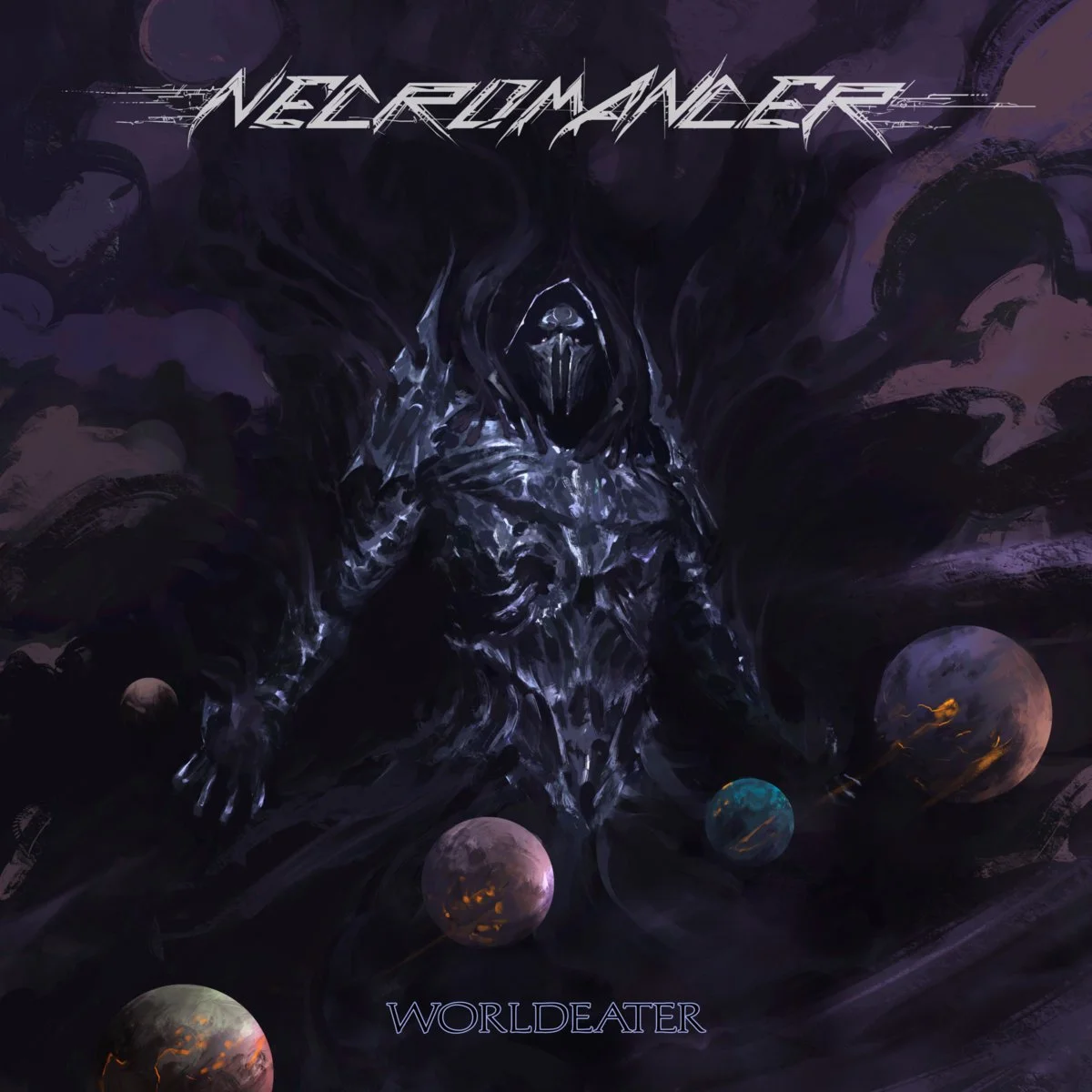
Necromancer’s WorldEater is a terrifyingly bleak, harsh slab of towering dark synths, tidal drums and crushing bass. The black gulfs of endless space yawn from this music while fear and existential dread permeate it. The tiny sparks of light feel mournful and insignificant in the face of the shadows pouring from this album.
Atmosphere is a crucial element in my appreciation of music. The dread-filled power of WorldEater creates a raging, Stygian impression while nervous-sounding synths tremble and snarling bass makes demonic progress through the album. In the more fragile moments, I feel profound sorrow as the shadows engulf the universe.
There is a sublime horror that fills the musical elements of WorldEater. The Cyclopean power of the synths that Necromancer uses in his music fills my mind with images of elder gods and icy destruction. The underpinning bass is like the voice of the void as it growls and the drums pound with intense weight and strength. The overall feeling is one of desolation and destruction.
I enjoy the way in which Necromancer layers all of his sounds. The complexity of the different auditory interactions catches my ears. It isn’t all unsubtle raging as the many synth tones, timbres and textures interweave to add depth to the seething blackness that reaches out dark tentacles.
My Favourite Tracks Analyzed
“Awakened” comes to life as a distant bell rings out and rain falls softly. A dark synth pulse slowly beats as metallic sounds clatter and a twisting, distant voice slips. A chilling, demonic voice speaks evil words into open space. Thunder rolls and a high, terrified sound rushes past. A single high chime tinkles and silence falls along with the twisted voice. The sense of omen and portent in this track is an excellent opener to the album.
Quickly spinning arpeggios full of nervous agitation join the sound of rain falling to start “Wrath.” Rumbling bass and a thumping kick drum move in as arpeggios spin up with worry and fear. A bass upwelling moves the drumbeat batters. A horrified sound rings out before the track drifts into a creaking, Stygian void.
Portentous arpeggios twirl while towering drums create a slow pulse and deep bass snarls. Taut strings twist out with a fearful motion as the arpeggio ramps up the feeling of threatening evil. Sparkling sound shimmers out above the tumbling arpeggios as looming bass rumbles.
Agitated arpeggios swirl while raised, bright sound trembles as powerful drums smack into the track. Every musical element effectively exudes palpable foreboding. Feverish light pours from the arpeggios while harsh bass moves in a heavy tide. The drums press on with fierce motion while higher sounds shiver before fading on hollow arpeggios and bass whorls.
“Leviathan” opens as steady, low bass spreads through the music with a muffled drumbeat. Both musical elements grow in power as a buzzing vibration shifts. A diabolical voice speaks as drums thud. A leaping, flashing synth pulse slices above growling bass and pounding drums.
Glowing synth wriggles in a minor key line before fragile chimes waver as soft crunching sounds shift. A bass void yawns below as buzzing synth slowly trembles into the openness around it. This track conjures up images of vast space and devouring evil in a way I enjoy.
A nervous, taut synth pattern cries out with dread above the drumbeat’s muscled strength and the bass weight far below. After a drum flourish, umbral bass growls and medium-high synth with a hollow feeling turns slowly. The chiming synth carries revolving arpeggios as massive drums hit hard below. The elevated synth conveys great fright and the music fades on dominating drums.
A steady, echoing high synth softly shivers as sibilant hissing drifts to start “Devoured.” Winds sweep and sigh as dense bass vibrates heavily before the drums attack ferociously as sawtoothed bass lacerates.
Glittering, raised arpeggios exude apprehension as skittering bass and smashing drums create a shuddering, uneven pulse. A continual high sound shifts before a delicate piano carries a melancholy series of softly touching notes. The piano’s fragility creates a superb contrast to the angry drum and bass assault.
Gritty bass surges through yawning gulfs of darkness. Lost piano notes are nearly swept away by a gleaming, unevenly tumbling synth pulse. The drums and bass slowly thunder as sparkling synth floats out above lugubrious synth chords. The continually shimmering synth rings and drums and bass lacerate as high piano notes are carried away into silence.
“Merciless” opens as intensely bright chimes ring out into cavernous space in a slowly wandering pattern. Harsh metal rings and a steady, doom-laden drum pulse throbs as angular sounds are underpinned by incredibly heavy bass. Muscled, serrated bass and shattering drums ram the music forward with raging strength.
Feverishly flaring synth tumbles in a sharp-edged cascade above the maelstrom deep underneath it. The lacerating low end storm thrashes against high notes shivering through the music. I find the way in which the track's grinding weight drives into the ears with unrelenting anger rather satisfying.
An empty void opens, distant brassy sounds howling out as grit-edged bass moves with horrible power as battering drums smack my ears again. Raised, shining synth carries a melody exuding anxiety as the huge tide below tugs and pulls at it. The chasing drum rhythm is doubled by surging synth pulses while high chimes flicker into silence.
Distorted, guttural bass growls as a steady ringing echoes in the distance to begin “WorldEater.” Jangling arpeggios spin with tense terror and drums smash shove the track forward on a tide of slicing sound. In the distance, flickering synth oscillates slowly while shadowed, crushingly heavy bass presses down.
Chiming synth cries out unevenly, permeated with worry. It spins into an arpeggio, undulating uncomfortably, as urgent drums and bass batter onward. Unfurling arpeggios effectively increase the sense of imminent danger. The bass claws my ears and a sonic cacophony snarls in the distance as silence falls.
“Enslaved” starts with a sound like a yawning grave. Scraping, metallic noises move as fragile, shimmering synth shines in the distance. A rush of icy air whispers through the music as a raised, tentative sparkle is now joined by jumping, heaving drums.
The elevated sound becomes a pulse that shifts side to side, ramping up the tension again. Hard-edged, razor-sharp bass slashes, touched by gentle glitter from an open-voiced synth. Now shining notes tremble into the surrounding openness, contrasted with the darkness engulfing them.
Demonic, guttural speech echoes as a delicate chime is buffeted by gigantic, rough-edged bass and heavily hitting drums. The horrific growl moves with threatening intent before silence falls.
Desolate, empty sounds are touched by a worried, glimmering arpeggio to begin “Offering.” The arpeggio slowly spins out into open space as a massive drum steadily pulsates. Raised synth sounds glow and scream, washed by fear. Crenellated bass lacerates and drums smash in hard. Shiny sounds scream before dark piano cascades in the distance and high synths chant.
Ripping bass tears the music and the chiming synth is full of warning while huge drums shatter. Glistening synth slowly drags above the slower drumbeat while all of the high sounds are panicked in effective contrast to the muscled heave below them.
A twisting chime flickers above the sepulchral bass that flows on and on. Wind blows across the emptiness around it before the drums attack. Creaking bass roughly breaks through as tortured synth howls far above the clotted darkness underpinning it before silence falls.
Conclusion
WorldEater is an uncompromising exploration of the unknown horrors that lurk in the lost reaches of the universe, waiting to rise and devour the Earth. Necromancer has done an excellent job of creating darksynth music that is as chilling as it is well-produced.
Jessy Mach - Night Shifter

Review by Karl Magi
Overall Album Impressions
Jessy Mach’s Night Shifter is an intoxicating brew of retro synth energy, strong vocal performances and skilful guitar work. The whole album thrums with life and unfolds in an exuberant flash of emotion and layered synth sounds. It’s an entertaining and engaging listening experience.
There’s an ear-pleasing retro feeling that suffuses Night Shifter. Jessy Mach draws together ‘80s synth sounds to produce music that captures nostalgia and clear passion for that era. I enjoy the way that the modern production quality allows the synth sounds to shine through with real dynamism.
Jessy Mach’s superb guitar performances are another reason for my enjoyment of Night Shifter. He has nimble fingers and a good ear for weaving solos that are expressive and intricate. The power and life within the guitar help to elevate the music to a higher plane of pleasing listening.
Along with Jessy Mach’s own vocal performances, his guest singers each bring their own sensibility to the music. The high quality of the vocals helps to lift the song’s lyrics and adds more depth to the overall auditory quality of the album. I enjoy the level of engagement the guest singers create.
My Favourite Tracks Analyzed
"Fluo Tail Lights” starts off as hard-edged, rapidly tumbling bass whirls in a fierce cascade. Low synth crunches into the music as massive drums pulse. Smooth, flowing synth gently descends as a high, sweeping sound calls out. Rapidly ripping sounds fly though the track above battering drums and urgent bass.
A gently flowing, enfolding segment unfolds in ear-pleasing contrast as warm synths climb like thermals. Quickly whirling, shadowy synth growls and drums keep thundering. Undulating synth slices and dark bass snarls far below as the drumbeat throbs. The track ends on caressing, flashing synth notes.
Medium-low, broadly flowing synth drifts in a gentle pattern above guiding drums and oscillating bass to open “Night Shifter.” The wide-sounding synth creates a calming pattern before Jessy Mach's distorted, but expressive vocals drift in a mellow melody.
A trembling synth pattern twirls quickly while brighter synth glistens in a trumpeting line. Jessy Mach trades off with female vocals before the solid bass oscillation moves into drifting notes that glide out into open space. Jessy Mach's guitar cries out with enjoyable, passionate intensity over the steady drum and bass heartbeat.
The vocals slip through and elevated, taut synth cries out. The guitar is unleashed in a solo that vibrates with emotional power. Gritty synth flies out above the wheeling guitar in its own howling solo before the song ends on Jessy Mach's voice.
The narrator speaks about how he’s so lost without the other person that it can “make me do anything.” He says that he doesn’t want know, implying that he wants to avoid hearing about the other person because “it’s just too much.”
“This Way” begins as lively, shiny synth leaps out in an energizing melody as hard-hitting drums drive and shimmering chimes dance. The lead synth has a rounded, brassy quality as it sings with dynamism and life. Jessy Mach's vocals are pleasingly warm-hearted and full of hope and need.
Rippling, string-like synth flickers in arpeggios as the guitar cuts in with more upbeat energy. An encouraging melody is carried on a soft-edged, medium-high synth. Jessy Mach's unique voice has an emotive quality to it as it moves.
A soaring guitar solo whirls out above rebounding drums and bass, in a coruscating cascade. Chimes flit and full-voiced synth dances to carry the main melody. Warming vocals slip along and the guitar intertwines with bursts of synth, lifting the song’s energy further.
The people who are “big faces around” tell the song’s subject what the narrator found. He says that he’s confused but hopes that it’s true that “I finally found you.”
He wonders what friend the other person used. Our storyteller says that he’s “scared to stand out” and he wants to run away. He concludes that “I really want to shout, I won't leave this way.”
Colossal drums pound in along with dense bass as “Find Love” commences. LAU’s soulful, expressive voice carries a melody that overflows with inspiration. LAU’s vocals are intensely elevating as Jessy Mach's guitar cuts in. The pounding drums drive on and brassy, glittering synth sings out a melody that explodes with joy.
I am drawn in by the sheer happiness in the chorus as it glows sunnily. The vocal melody grows tender as it flows and again the deeply-felt lyrics are carried by LAU’s retro-tastic voice. Drums and bass keep the energy levels high while Jessy Mach's exuberant guitar intricately flies through the song.
The storyteller addresses another character and talks about how they are trying to find the love of their life but “on that road you did suffer.” She says that person is clinging onto hope and “if you don’t know, it won’t hurt.” She adds that the song’s subject is getting tired of searching but “you can make it happen.”
In the chorus the narrator is encouraging, telling the other person that they can be “the lover you want if you can take it.” She adds that the song’s subject doesn’t recognize themselves but “you can’t help it.” She points out that the other person can’t give up until they find love.
Our storyteller goes on to say that even when the days are long and “you’re feeling low” the other person has to get up. She says that it’s getting harder for the song’s subject to hide their emotions. Now the song’s subject is holding onto hope because “you know you really want her.”
As the song concludes, the narrator asks, “Should you be searching for her? Would you know when you find her?”
Slightly gritty, sombre notes echo in a slow arpeggio that grows in energy to kick off “Lifeline.” The synth divides and tumbles as Rebecca Davies’ highly emotive voice calls out with warmth. Her voice pours effectively pours out expression as deep bass throbs.
The vocal melody is full of pain, a needy ache within it as the slow arpeggios turn. Rebecca Davies’ voice trembles and hurts as a shimmering arpeggio spins faster and drums guide the music. The vocal melody is full of melancholy as the drumbeat presses on and surging, vibrating synth notes move.
The way in which this song showcases Rebecca Davies’ performance is deeply pleasing for me.The surrounding musical elements add even more feeling to the vocal performance and melody. We end on broadly echoing notes.
Our storyteller muses that a time may come, “maybe when I’m over the fall” and ready to run again that the other person will “find yourself in the path of another.” She adds that each time she makes a mistake “every little bit of me aches, every little piece of my heart breaks.”
She addresses the other person, saying that when they find themselves in a lover’s arms, it’s easier to “think that I’m wrong (and) live in the dark” but points out that really “easy isn’t easy at all.”
Now our narrator talks about seizing the opportunity right now, adding that “memories make memories.” She asks if what the other person wants is all of her energy.
The narrator muses that it might be a matter of time for them to have chances to “live in the same life (and) to figure it out.” She hopes for a time when they don’t doubt and concludes that “I know that I can do this without you, you’re a lifeline."
“Wheels Of Hell” comes to life against a deep bass backdrop as medium-high, gruffly shining synth floats out in a fragile melodic line. Now sharply glistening synth rings out in a slow moving arpeggio.
Angular, insistent synth flies out above throbbing drums and rich bass. Medium-high, full-sounding synth carries a victorious melody out above the powerful drums and bass. Jessy Mach's guitar flows out and a voice echoes through. I enjoy the dynamically bursting guitar sound in this track.
Wide-sounding, bright synth flares into life and glimmering notes rise as gruffly shining synth twists. The music moves into a segment in which Jessy Mach's guitar shivers and cries out while drums and bass push on. His guitar solo is intricate and full of energetic motion. Ringing notes dance out and the beat drives on below as the track ends on glowing synth.
Conclusion
Night Shifter bursts with energy, expression and neon-drenched sound. Jessy Mach and his musical guests create an intensely engaging atmosphere within the music and keep me listening as the album unfolds.
- December 2025
- November 2025
- October 2025
- September 2025
- August 2025
- July 2025
- June 2025
- May 2025
- April 2025
- March 2025
- February 2025
- January 2025
- December 2024
- November 2024
- October 2024
- September 2024
- August 2024
- July 2024
- June 2024
- May 2024
- April 2024
- March 2024
- February 2024
- January 2024
- December 2023
- November 2023
- October 2023
- September 2023
- August 2023
- July 2023
- June 2023
- May 2023
- April 2023
- March 2023
- February 2023
- January 2023
- December 2022
- November 2022
- October 2022
- September 2022
- August 2022
- July 2022
- June 2022
- May 2022
- April 2022
- March 2022
- December 2021
- November 2021
- October 2021
- September 2021
- August 2021
- July 2021
- June 2021
- May 2021
- April 2021
- March 2021
- February 2021
- January 2021
- December 2020
- November 2020
- October 2020
- September 2020
- August 2020
- July 2020
- June 2020