Eclectotron - Galactic Trash
Review by Karl Magi
Overall Album Impressions
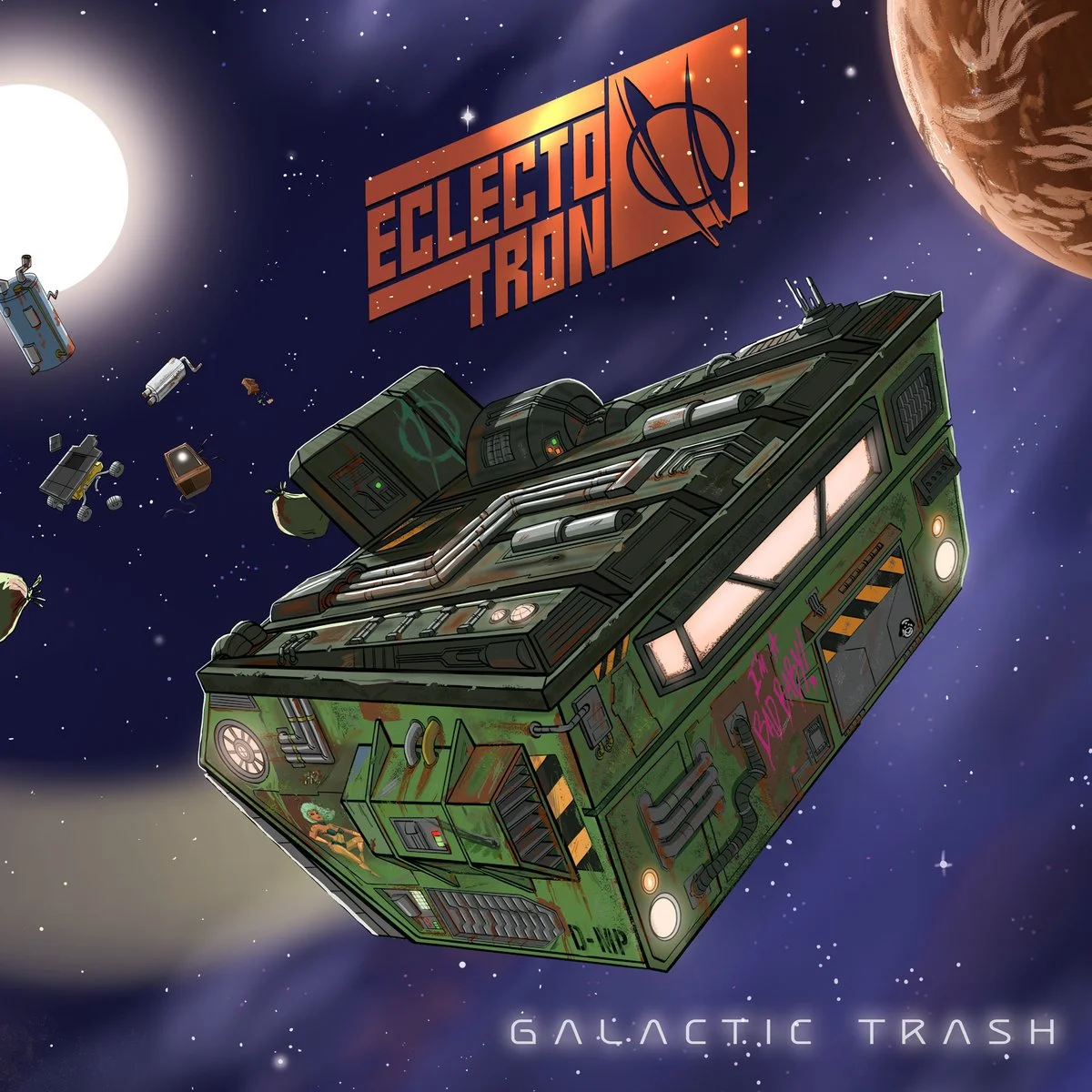
Eclectotron’s “Galactic Trash” is an absolutely charming synthrock journey with stops along the way for disco and punk inflections. It showcases excellent guitar solos, vocal performances full of life and backing drums and bass that lock into an undeniable groove. The way in which the album moves from sci-fi action to playful moments creates a listening experience that I deeply enjoy. When one adds in the first-rate songwriting and melodic evocations of emotion, the end result is an album that I find compelling and intensely entertaining.
Madison Lowery takes hold of the album’s main vocal duties and absolutely nails them. Her voice can be gentle or ferocious, moving with lightness or guttural weight and imbuing each song with character and expression. Her voice is well suited to the music on “Galactic Trash” with her ability to be ironic and wry along with delivering moments of epic majesty. I also want to mention the way in which Reese Miller uses the talkbox to add a robotic quality that suits the sci-fi feeling of much of the music.
The songwriting on “Galactic Trash” is superb. The songs have narrative depth and many moments of humor along with genuinely touching lyrical turns. As the band’s name suggests, the subject matter is eclectic, moving from space vistas and galactic adventures to lonely robots and monsters with a fashion sense. Each song unfolds with originality and heart-on-sleeve emotion, pulling me further into the album as it evolves.
As Reese Miller, Francis Roberts, Oliver Brink and Paul LeSchofs bring their combined instrumental talents to bear, they create a background that is well calibrated to the overall feeling of “Galactic Trash.” Reese Miller’s synth work adds dynamism to the music, while Francis Roberts plays guitar solos that shred and fly with thrilling strength. Oliver Brink and Paul LeSchofs ensure that the drum and bass heartbeat goes on and the way the combined band supports Madison Lowery’s vocal performances creates music that I find hard to put down.
My Favourite Songs Analyzed
“Fearless” comes into being as Reece Miller’s synth creaks and the drums flourish. Oliver Brink's bass pumps as the electric guitar leaps to the fore with a minor-key melody full of threat and growing strength. The disco beat drives Madison Lowery’s vocal performance as it rips into the music.
The synth slices with a keen edge as the crushing low end moves with Francis Robert’s guitar while twisting notes tumble together. Madison Lowery’s voice is triumphant as it rises in the chorus, intense and full of aspiration and shadow, while a minor-key guitar snakes through the music. The way in which hard-edged sounds move with bass funk and groovy drums creates an entertaining contrast.
The song is full of gritty dynamism and unceasing force as it unfolds. Madison Lowery’s performance is defiant as Paul LeSchofs hammers home the rhythm and a synth swirls with computerized clarity. As the song ends, it does so in a rush full of victory and sobbing guitars.
As she feels “the energy rise up from the street,” she hears a familiar dull, thudding beat in the distance. She adds, “To make it, we’ve got to go to a place we believe in.” As the darkness is sliced with “razors of light,” there is a “glowing Shangri-La” revealed that only comes out at night. Our storyteller points out that it’s time for the show.
Without fear, the narrator stands in front of the crowd “in a sea of sunless eyes, all ablaze.” There’s a “fantasy of light and wire” given energy by the desire of a group, an energy that is already being undone. She continues, “Take me now to where I feel at home, to the backlit towers looming in the haze.” Before sunrise, this world will be undone and while it starts to fade, “the memory remains.”
As there is “neon burning in our hearts and fire in our lungs, the taste of lurid venom on our lips and our tongues” our storyteller realizes that the luminous vision must disappear even as “you close your eyes and arrive there.” As blood runs hot, “the sky seems to crack, a blinding white eclipse that tears our minds from the black we know; to make it, we’ve got to go.”
A voiceover about space pirates is joined by Reece Miller and Francis Roberts’s guitars charging with vibrancy as “Space Pirate” starts. Paul Leschof’s drums shatter and Oliver Brink’s bass adds weight. Madison Lowery’s voice detonates with exuberance and playful expression as the rushing guitar chugs and the ironic nature of the performance puts a smile on my face.
As the chorus explodes, soaring upward with a sense of rebellious progress, the vocals capture all of the spirit of the lyrics. Now Francis Robert’s guitar melody soars like a spaceship blurring into hyperdrive, climbing with irrepressible dynamism. Madison Lowery’s voice reaches out again, full of joy and victory, while the punching drums speed along.
The chorus flies again, full of strength and optimism while Francis Robert’s guitar vaults upward. A storming guitar solo slices through the music, full of intricacy and danger as the drums rush along. As the song ends, guitar screams with unbridled freedom and the song closes.
With a sigh of resignation, our storyteller says, “Here we go, not again, space pirates boarding us once more.” Once again she and her crew find themselves being raided. You can almost hear her shrug as she says, “We’ve been through this shit before.” They are going to get robbed and, in response, she says, “Fuck this job, ’cause we’re not paid enough for war! They’re breaking down the motherfucking door!”
“Once inside, pistols high, they shout and threaten all our lives,” so the narrator urges them to take everything and take their time doing it because “none of this shit’s even mine.” She is inclined to learn something this time, adding that it is “time to change our motherfucking lives.”
She realizes that she wants to “look and feel” the same way the space pirates do, with “the way you talk and move and fight too.” Now our storyteller wants to be given “confidence, arrogance, an air of bold resilience,” as she takes “the things that make you you and steal them all for me.”
Now surprise fills the narrator as she says "smoking gun, I'm alive, I can't believe he missed that shot." She was sure she'd die but it seems she hasn't. She goes on to say "now's our chance, take him out. We’re giving everything we've got, it's time to finally live the life we want."
To conclude, the narrator wants to be a space pirate, “captain of the void above,” with her future blazing before her. She wants to “leave the galaxy behind me as I flash into the cold dark night.”
“Failure of Form” commences as a catchy little bass lick joins a jumping bassline while Francis Robert’s guitar carries a melody full of rising force before the robotic vocals are joined by Madison Lowery’s warming vocal performance. The bouncing beat and entangling bass move briskly while the vocalists create drama with their voices and a disco-inflected rhythm rides through the music. The way in which the lyrics mirror the vocal performance adds to the feeling of communication between robot and human.
Francis Robert’s guitar unfurls with a melody full of lively, responsive feeling while Madison Lowery and Reece Miller create a groove with their vocal performances, the talk box adding to the feeling of mechanistic, computerized beings. The underpinnings continue to rocket forward while Reece Miller’s synth radiates an astral shimmer and the guitar intermingles with the vocals. Paul LeSchofs locks the music in while a floating guitar cries out with triumph, flying above the track with unfettered effervescence and a harpsichord-like synth twinkles with metallic luminosity. Oliver Brink's bass guitar thunders while the lead vaults to the skies. As the song ends, the vocalists sing unaccompanied before the drums return, followed by the other instruments and silence falls.
As our first robotic narrator speaks of “being cast aside from your home, not broken, simply left on your own,” he is joined by the main character, who mentions being inside “a construct in your head” and adds that perhaps “you wonder: was it just yourself who left you for dead?”
Now both storytellers talk about a basic thing like losing it all, with “a core directive falsified, a time and place you could not rise from the fall.” After one’s “internal purpose liquefied” and a “deliverance of function, a failure of form,” there are negated expectations and “a span of operation lost in a storm, depleted by our own design.”
The two narrators find a “program defect” that cycles down and then repeats with a “subroutine wiped and left incomplete.” Despite this, they point out that the sunrise still happens every day and that “in the darkness there is still a chance to find your way.” It is just a matter of activating your vision with the luminosity in your mind as you “analyze the data, colors all redefined.” As the sensory information flows, “there’s a shift in energy.”
As the song closes, both storytellers say, “designate the problem, eliminate the source,” because time is endless and one can “use it to plot a course” and discover in the end that you have been realigned.
With a distinctively Spaghetti Western feeling, the mood is set for “Stick ‘Em Up.” The twangy guitar adds the perfect introduction before Madison Lowery’s exuberant voice spills into the music. Drama fills her unique performance while the drum beat locks in with a surf rock feeling and the backup singer adds his own voice to drive the performance onward. Reece Miller’s elevated synth wanders in the distance while the underlayer rushes forward and the chorus climbs with a sense of impassioned attraction and a story of galactic thievery.
I quite enjoy the tone and delivery as Madison Lowery belts the song out with vivacity. The punk elements add even more stomping sensations while Paul LeSchofs pounds the skins with serious force. Oliver Brink's bass guitar rumbles while a distant synth roams with a theremin-like sound. The chorus carries a hint of affection while the song presses forward. Madison Lowery dominates the track with her driven performance and Francis Robert’s guitar carries the melody of “Ghost Riders in the Sky” to wry effect. In the distance, the chorus evokes Ennio Morricone before the track rockets into battering madness. The song ends with Madison Lowery capturing loss and betrayal.
As our storyteller points her gun in the faces of those they are robbing while “broken and smoking sentry bots” flash red, the second character shakes them down for their money. He throws her a wink, adding that he isn’t playing and she should “start the hyperdrive now or we’ll both be dead.” She adds, “We blasted our way, turning night into day into orbit, another Nebulan bank with its record profits drained.”
The song’s subject promises that nothing can stop them, so “kick off those boots, climb up and make the ship shake.” The narrator never wanted a partner, drifting through space by herself, but “you stole my heart, gave me cosmic wonder,” so with a purpose she never sought out, “hand in hand we say stick ‘em up, give us all you got.” Now they are “robbin’ and lovin’” as they soar through the stars together, running.
They share passion and gunning, adding “firin’ from the hip, this is love on a starship.” They find themselves making noise with “sentinels poised for destruction, blaster fire rippin’ past our heads.” Our storyteller wants to break the cycle before “we wind up on the run, facing down the gun of the lawman.” She says that the song’s subject devises a plan that could set them free: they would “filch the dogged dark matter diamond” and get married.
Their plan proceeds without a hitch as they break into the vault and grab the dark matter diamond while “sentries swarm right behind us.” They fight their way out and into their ship, issuing orders and flying away, barrel-rolling through space. The diamond is meant to be “our future wreathed in black,” but she feels the song subject’s gun at her back as he says, “Sorry, my love, but it’s gotten too hot, the jig is up, my dear, stick ‘em up, give me all you got.”
“YS-1” begins with huge guitar chords and explosive drums creating a rushing pulse before Reece Miller’s talk box evokes a lonely robot left on a far-off planet, roaming through a wasteland as he contemplates his existence. The way in which the melody captures affectionate, wistful sensations is matched by the softly touching vocal performance, filling me with brokenhearted loss. The gently twinkling background shifts as Reece Miller joins with her aching vocals and Reece Miller’s resonant synth adds a razor-like quality.
The way in which the robotic voice reaches out feels broken and bereft. Starlight shimmers and Madison Lowery evokes the existential brokenness of the main character. Images of red dust and endless wandering permeate the song while the fluting synth intertwines with a shining guitar as Paul Leschof’s drums march on. The lead synth is full of yearning and pain while iridescent notes arpeggiate with fragility and trickling tones ripple. The drums flourish and the main melody hovers with graceful, emotive sensations before the song breathes to an end.
Our narrator does not know if it was something they said, deciding that perhaps it is better this way. However, “I can’t get those memories out of my head, let me come home to you someday.” They wonder how long they must remain alone in “dust, rocks and darkness” before the other person says they are happy with them.
For now, the storyteller will “just keep rolling on and on through this crimson wasteland” and concludes that perhaps this is where they are meant to be. They add, “My mission has been productive and serene, I feel that I’ve done what I had to do.” As the song concludes, the narrator says, “My battery is low and it is getting quite dark, my final thoughts are of you.”
Strange alien sounds move along with intertwining bass and a guitar howling with ferocity to start “Face Ripper.” Madison Lowery’s voice snarls with malevolent hunger while Paul LeSchofs smashes and theremin-like sounds roam in the background with ghostly discomfort. The two singers bring their voices together in devouring tones and a minor-key melody full of grasping drama.
Oliver Brink's bass entangles heavily and the muscled drum beat shatters the music. I enjoy the sensation of deadly threat while a theremin wriggles with discomfort and growling vocals claw at the track like honed talons. The guitar and Reece Miller’s spectral synth wrap around each other while Paul LeSchofs hammers hard on his drums. Francis Robert’s guitar lacerates while the vocals hit with dangerous potency.
Francis Robert’s guitar rushes forward with unstoppable rage while the drum beat bashes and the track slows to half-time, guitars churning as it marches with evil force while Madison Lowery chants. Screams echo in the background as the heaving underpinnings surge forward and the guitar cries like a tortured soul before silence falls.
“A vile infestation” lurks in the shadows as death awaits “patiently despite your desperation.” Our storyteller adds that the song’s subject is “bound in time, soon to die.” She finds it difficult to hold herself back, pointing out that it is “a shame I have to end you, but you won’t die in vain,” because eternity is waiting.
Asking, “How am I to blame? Such beauty is entrancing,” the narrator has staked a claim on the song subject’s likeness because “my wardrobe needs enhancing.” She states her intention to “rip your face right from your skull and tie it in a bow, stitch and sew your visage into fashionable clothes.”
Compelled by the song subject’s face, our storyteller realizes that “I simply have to know how your semblance complements my dress of tortured souls.” As the song concludes, she says, “sharpening the instruments of gruesome desiccation, grinding metal drowning out the sounds of protestation, flash of the blade, skin and sinew flayed.”
“Late to the Party” kicks off as a brass section launches into a melody that blooms with energizing sensations before the disco beat locks into a solid groove. Reece Miller’s talkbox vocals seamlessly harmonize with Madison Lowery to create a unique auditory environment while the drummer and bassist create an undeniable boogie. The lead melody is full of positivity while the two singers create a fascinating blend between robotized and human singing.
The low end has an ear-pleasing swing to it while the pounding beat adds propulsion. Reece Miller's synth solo swirls out with a flourishing feeling as it wheels and spins while the vocals grab me with their playful vibes. The beat continues to throb while the vocals climb and the song comes to an end with joyful abandon from the singers.
Looking down the street, the narrator wonders what’s happening and why there are “so many people that look cooler than me.” They go on to say that it looks like a party where the drinks are flowing and “the neon colours are a marvel to see.” They add that they have heard about this party before from their friends.
Our storyteller continues, “It looks like lots of fun, so I’m going to show, I feel the beat and like the dude ratio.” Our storyteller wants to head there but does not want to look too square, “dressed in my finest and I never knew I liked it so loud.” They now realize what it could all be about and feel compelled to join the crowd.
They are “late to the party” and think people have heard this song before, feeling “like a dinosaur.” The narrator wants to meet new friends and hopes the party never ends. Everyone may have been going there for over a decade, but “holy shit I dig this shit like never before.”
Our storyteller goes on to say, “We’re going hard until the owners lock up the door with neon in our hearts and minds forevermore.” They conclude, “Late to the party, fuck the space patrol and fuck the cops. Late to the party and we’ll synthesize until we drop. I hope we never stop.”
Francis Roberts' guitar jumps with untamed vitality as the drums and bass interlock in a raging charge to begin “Danger Inbound.” The talkbox introduction moves with Madison Lowery’s intensely driven vocals while the drummer attacks and Oliver Brink’s bass throbs. Madison Lowery has a sense of freedom in her voice while Paul Leschof’s percussion shoves forward.
The main melody erupts with adventurous and thrilling strength while the rushing underpinnings are joined by Francis Roberts' guitar as it bends and flies like a spacecraft in wild interstellar combat. The underlayer rages as the vocals flame with combat-driven passion, filling me with adrenaline that permeates the song.
Galloping drums and bass are joined by flaring guitar and a hammering beat as the chorus climbs for the stars with unadulterated animation. The melody is triumphant, carrying the rush of combat as the percussion speeds onward. Now a galvanizing guitar solo leaps forward and the track explodes toward its conclusion.
As the onboard computer tells the narrator that her objective is cleared and it is plotting a course home, she says, “I’m about ready to shut down and call it a day, computer return to docking bay.” However, the situation changes quickly and she is warned that there is incoming pilot danger. She curses, “What the fuck is it now?” to which the computer replies that an enemy squadron is approaching and cannot be evaded.
Given no choice but to fight, our storyteller says, “Well then let’s set them alight in the flame of our retribution now.” With a “20/20 drop-in sight,” the enemy closes in and the forward thrusters spark to life as the narrator says, “Baby don’t fail me now.” She wonders if they will win the fight or “be swallowed by endless night,” and as the weapon systems come online, she promises to “engage and strike them down.”
Once more, the narrator puts her life on the line in one more fight to “live inside this momentary high” and one final time to “sanctify my guiding light.” She declares, “I survive or I will die, in the end I live to fly.” As the targets ready their weapons, she commands, “Prepare to break, execute evasive maneuver 8,” and adds,“I’m about ready to burn these bitches away, releasing a blast from the laser banks.”
Now the computer informs our storyteller that there are two fighters down and she should switch to projectile rounds. More fighters appear off the bow and they are banking left and rolling down while a warning sounds that they are locked onto the ship. As the song ends, “incoming missiles will hit and we’re lost in the sea of light and sound.”
“bab3dotwav” comes to life as galactically twinkling notes move with Madison Lowery’s voice, capturing a romantic feeling. Into this softly gliding world of sound come explosive notes shining with dramatic emotion, while Francis Roberts' guitar slashes with intensity and Madison Lowery’s voice erupts in Japanese, evoking the feeling of an anime theme song.
Paul Leschof’s hard-hitting drums join the uplifting chorus with thrilling drama and the playful words take hold of me. Francis Roberts' solo flickers out with a sense of anime joy while the voiceover adds to the atmosphere. The rushing drum beat pogos as the soaring chorus bursts forward with mingled strength and fun-filled life, while the guitar howls again with exhilaration, climbing through an intricate solo with unconquerable liveliness.
The chorus returns as Oliver Brink and Paul Leschof propel the music with madly driving power while Francis Roberts' shredding guitar whirls once more. As the song draws to a close, the voiceover drifts in the distance while the guitar shines with brilliant radiance.
As the song begins, our storyteller says the song’s subject burns brightly in the sky, adding that she is a fearless person. She asks, “Who is that dancing figure?” and the reply is that she is a special person who moves like an eel. She goes on to say, “I’m about to be eaten by her, but that’s what makes it so thrilling.”
The narrator says, “B A B 3, it’s not an acronym, it’s just what they call me,” explaining that she is wild and free on the marquee, destined to be the knees of bees. She concludes, “OK class, now you see, it is time to sing with me.”
As Francis Roberts' anthemic guitar climbs majestically and the percussion shatters into the music, “Andromeda” opens. The guitar accelerates with nobility and force while Madison Lowery carries the full emotional weight of the lyrics. Backing vocals join with boosting strength and the words soar out with regret while the foundation pushes forward.
The chorus rises with love and damaged emotion, while the glittering guitar emphasizes Madison Lowery’s vibrant and forceful performance. I’m drawn to the full expression in her words while the bass and drums once again form a tidal force. The guitar climbs with stellar drama and intense strength as Madison Lowery pushes the lyrics home with irresistible feeling and the chorus swells again.
Francis Roberts' guitar solo arcs with wild passion and freedom as the drummer hits hard and the chorus climbs once more with a mixture of ardent emotion and yearning before the song ends.
“Before I saw you, I’d never known this longing deep in my heart,” and as the narrator lies cold and lonely, she remains torn apart by thoughts of the song’s subject. It once seemed unimportant and she was told that the subject would never return. She declares, “I’ll live a thousand lives on my own and into you my spirit will burn,” after all the valuable time wasted and “this vicious love I’ve tasted in search of you and I.”
As the darkness fades into light in the “sweet breath of the night,” our storyteller speaks of “flashing through the black unending, toward the sweet sublime ascending.” As she addresses Andromeda, she can feel her soul sliding away while the star is “burning brighter through each mind.” As the eons pass, she continues to travel, adding that she would live a thousand lives for Andromeda.
The narrator has felt Andromeda’s presence for her entire life, saying, “I saw you shine from afar, I sacrificed what I could have been to have myself consumed by a star.” She wonders if she can remember another name, “a memory from lives long ago,” and questions whether she can hold on to the promise she made and “turn my back upon this world that I’ll never know.”
Conclusion
“Galactic Trash” is a unique and joyful musical journey that feels fresh and entertaining. The way in which the stories are told and the moments of humor leaven some of the darker and more emotional experiences form an intergalactic adventure that I find a huge amount of fun.