MICHAEL OAKLEY - Prologue Interview
Foreword and Interview by Vero Kitsuné
Canada-based Scottish synth maestro MICHAEL OAKLEY is back with a new long-play entitled “Prologue” - a 10-track masterwork that showcases a fresh new perspective and trajectory for his own brand of synthwave and synthpop. After leaning into warmer textures and softer atmospheres on 2021’s Odyssey, Michael Oakley returns to full synth-driven form with Prologue, an album he describes not as a continuation, but as the beginning of a new creative chapter. The artist-producer teams up once again with longtime collaborator Ollie Wride, delivering a record packed with cinematic hooks, polished production, and unapologetic retro energy. Tracks like “Warriors Of The Wasteland” channel arena-sized ‘80s swagger, while “Memory Of You” (co-produced with Missing Words) and “Falling Skyward” showcase Oakley’s signature blend of transatlantic synth-pop and widescreen emotion.
Elsewhere, Prologue explores a broader sonic palette without losing its nostalgic core. “School” fuses dance-pop nostalgia with classic new wave flair complete with backing vocals from popwave favorite Dana Jean Phoenix, “World Of Promises” introduces darker rhythmic textures, and “Hurts Like Heaven” — featuring Holly Dodson of PARALLELS — bursts with euphoric Europop spirit.
Oakley has compared the album’s ambition to imagining Violator-era DEPECHE MODE produced by Trevor Horn, and while the comparison is bold, the intent is clear: Prologue is confident, expansive with a grand vision, and easily his strongest release to date.
We caught up with Michael Oakley to dive deeper into the making of Prologue, exploring the stories behind the album and his evolving perspective on the world of synth-driven music.
It has been 5 years since your 2021 LP Odyssey, where you began exploring sounds more reminiscent of early ’90s synthpop. How would you say your sound has evolved since then for Prologue? What is the lore and growth behind that evolution?
Michael: Well, Odyssey was the shortest recording period that I’ve ever taken to conceive and develop an album start to finish (within one year). I felt so completely burnt out from it that I decided to take a year off from music and forget everything I knew about how I was approaching being creative. I always vowed that if there was ever a time when I wasn’t enjoying making music anymore, I’d stop until that feeling changed. Synthwave as a genre was really not inspiring me anymore and all the pioneers had either left or started to move in different directions musically away from the scene.
One thing that did stay with me however, was at the back of my mind I had this persistent thought about somehow bringing 90s dance influences into Synthwave. I wanted it to be reminiscent of the music I listened to at high school in the actual 90s, but the only problem was I wasn’t sure how to do it in a way that made sense and translated well to a modern audience. It’s so easy to do 90s music in the wrong way that it becomes like a bad parody of that era. A lot of 90s music hasn’t aged well either and I knew that was in part because of the shift away from the warmer 80s production and recording techniques into the colder sound of the digital age where people stopped recording to tape and analog synthesizers got replaced with romplers, samplers and virtual analog synths.
Then in 2023 I went to Neon Synthwave festival show in Florida and after enjoying the event as a fan, hanging out with friends from the community and feeling all the love from those wonderful people, something clicked and I came home and started writing again. I fell back in love with Synthwave and realized I could bring those 90s influences back in a way that worked with my favourite 80s production techniques and also still retained an emphasis on songwriting at it’s core.
Your brand of synthwave doesn’t really harken to the typical palm trees and neon sunsets vibe. What were the vibes you had pinned on your vision board while working on Prologue? And were there other genres that helped shape it?
Michael: Three albums on vinyl were put up on the mantlepiece in my studio and became the trifecta of references to keep me anchored if I strayed too far in the wrong direction: Depeche Mode - Violator, New Order - Technique, & Electronic self titled debut album. The one constant on those albums were the tasteful use of synth sounds and also brilliant songwriting.
Eurodance music and Trance is something I absolutely love and have unwittingly put in my music over the years but held back for fear of losing balance. On Prologue I was conscious of leaning into that more on songs like Memory Of You, Hurts Like Heaven & School. I was also playing Cyberpunk 2077 at the time and that video game really immersed me both feet in the Cyberpunk world that would become part of the inspiration behind the sound of World Of Promises.
One thing about me is I get bored if I stay in the same place too long and I have a neurotic thing about wanting to make sure no two songs of mine sound the same sonically, let alone albums. Palm trees and neon sunsets were for sure part of the overall vibe on my first EP California (2017), inescapably so as I ingratiated myself into the Synthwave world but it became very limiting after a short time. There’s only so many ways to reimagine the same thing before the magic of that dies. Hence why I like the challenge of doing something new all the time. There’s an element to that where I don’t know what I’m doing and you land on happy accidents as much as trying to forcibly move in a certain direction through intention.
You’ve done sound design and sample/VST library work for companies like Roland, Splice and Cherry Audio. When producing your own songs, what usually dictates the direction first — composition, technique, sound design, or something else?
Michael: It can be any one of those things that spark an initial idea but believe it or not when I sit down to write I usually start working with presets to get the initial vibe I’m looking for down, then fine tune the sound design later. I find if I sit and sound design first then hours pass and nothing happens because my focus is on the tone more than say a riff, chords or any sort of melody to work with. Getting the overall mood and vibe you’re trying to create down first is the most important thing for me personally. Then out of that bed you’ve created, a melody line starts to form and then you can start to figure out lyrics / concept and then as that part of the song develops you then go back and change the structure to work with and compliment it.
Sometimes if I’m out on a walk listening to music on my iPod (yes I still have one of those lol) I’ll hear a song or an instrumental track with something that grabs my attention. Maybe it’s the chord progression or maybe something as simple as the drum programming. This has made me want to go home and try to create something with that same vibe and that becomes a jumping off point for an idea.
We are incredibly fortunate to live in a time where you can easily find mix ready drum samples and every synth plugin has a universe of third party preset packs in any style you could imagine that get you in exactly the sonic ballpark you’re looking for immediately. Not only that but these samples and sounds are done by people who are marvellous sound designers. One technique I like utilizing is using presets from other styles of music (Trance, EBM, Progressive House etc) to find something interesting and pull that into my Synthwave world. I purposely avoid using Synthwave presets because those can be quite limiting and lead you to something that’s been done a million times before in the genre. Working with sounds from other styles is how you can add your own signature to it all because you’re still the one choosing the sounds from those styles which appeal to you.
What would you say are the essential things synthwave producers should keep in mind right now to avoid falling into genre tropes?
Michael: I’d say the fatal mistake most producers make when coming into the genre is thinking they are making ‘Synthwave’ music. As soon as you adopt that mindset your world immediately becomes smaller because you start creating music that sounds like everyone else in order to fit in and be accepted. What people want is to hear you sound like you. Every one of us has our own favourite artists and for me mine are Pet Shop Boys, New Order, Depeche Mode, 90s Eurodance music. You can hear those influences all over my music if you go looking for it. That’s what makes my interpretation of Synthwave unique because it’s centred around my preferences and not centred around genre cliche’s and tropes. Undoubtedly I gravitate towards some elements that could be considered Synthwave tropes (80s drum samples / Roland Juno synth sounds / 8th or 16th bass patterns) but I’m conscious enough to use them in a way that isn’t banal or the forefront.
Also the most popular artists in the genre: The Midnight, Timecop1983, FM84, Gunship etc all have their own unique sound. If you want to stand out in your own way then don’t try and sound like them because you’ll always be in their shadow.
Be honest — have you ever written a song and thought: “This needs at least 17% more neon”?
Michael: Yes. There have been some times during the shaping of the sound of a song I’m working on where I felt the balance was off too far in one direction and I had to rebalance it more around 80s production / synth sound choices or drum sound choices to make it feel more congruent with what I feel a Synthwave audience would appreciate. My feeling is if I wanted to do a completely left field style then I should create a side project. Michael Oakley the solo artist for sure will always centre around retro based styles because that’s where my heart lies.
Where do you think the synthwave genre is heading? And most importantly — will it still be synthwave?
Michael: I think that the genre has been stagnant for a while, largely down to an influx of people that came into the scene doing pale imitations of former Synthwave glory’s and not adding anything new. There have been very few high points since 2021 but I do feel a shift happening. Mostly around 90s influences becoming a dominant feature and infiltrating the scene. It will still be Synthwave appropriate because in my mind Synthwave always felt like a new wave of synth artists who borrowed from the past in order to create something modern. That encompasses 90s as well as 80s. Also Italo Disco crossed with Darkwave / EBM and Industrial is creating some really great and unique people emerge out of that scene into the Synthwave scene.
Who do you think are the most compelling and forward-thinking artists reshaping synthwave today? And are there any rising stars we should be keeping an eye on?
Michael: My top picks would be Ollie Wride, Missing Words & Yota as three artists on NRW who are head and shoulders above most and are consistently creating incredible productions with everything firing on all cylinders. Even though music is subjective, I’d challenge anyone to name me 3 better artists currentlycreating at a higher level asides from The Midnight. Not to say there isn’t other really great music out there, but in terms of consistency and quality those three are my personal picks.
You’re one of the very few artists out there who seems genuinely savvy about fashion and styling as a form of expression, and you’re not afraid to wear bold looks that really stand out. Who do you look up to, and who are some of your favorite designers?
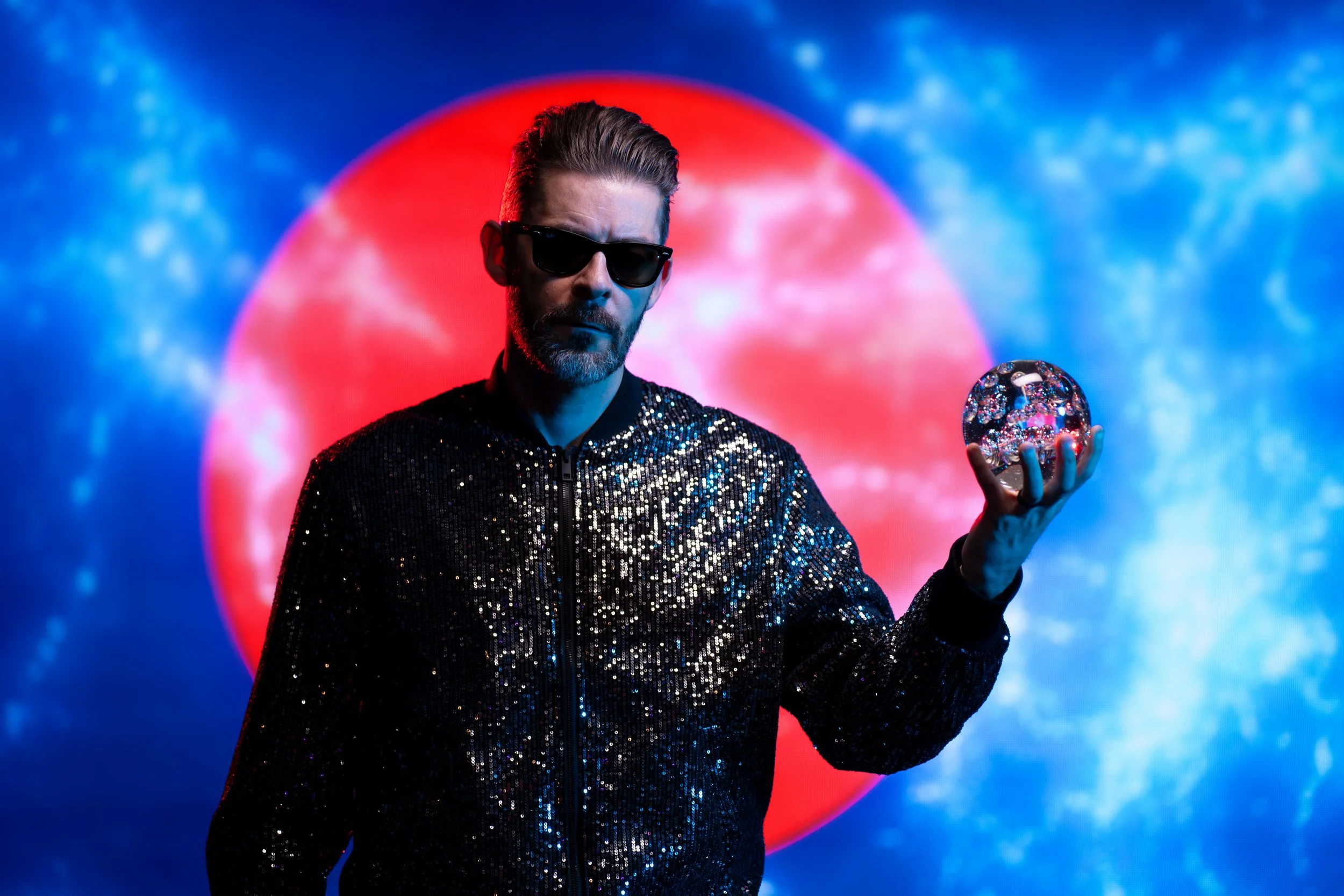
Michael: Thank you! We people from Glasgow have a knack for style and like nice clothes! I feel like style is crucially important as part of the presentation that goes hand in hand with your music to give a sense of your identity / personality within it. Allsaints are the designer brand I’ve worn consistently in most of my photos / videos over the years. All my leather jackets are from them and they make the best jeans. I like shiny things like sequin bomber jackets and have picked those up from all over the place like thrift stores, vintage shops and even H&M. If I see something I like, I buy it and keep it in my wardrobe for later. Some of the outfits I wore on the Prologue shoots were things I picked up 2 years ago and knew I’d wear them later. Ralph Lauren is always classic and I love dress shirts from them.
If someone made a “Michael Oakley starter pack,” what absolutely has to be in it besides synthesizers and sequined bomber jackets?
Michael: Omg can I really be the one to appropriately answer that? lol Cats, Xbox gaming, Newcastle United & coffee. There you go.
What’s next for Michael Oakley?
Michael: Prologue is the start of a new chapter for me and I will continue that evolution into more 90s influences I feel. Now that I’ve laid the starting ground work on that I can for sure see those 90s influences becoming more prominent. Hard to say though because I act on how I feel at the time and what I say I’ll do now can change in a heartbeat later depending on my mood, but I don’t want to take another 5 years to come back with another new album. For now though I’m going to enjoy promoting Prologue and take in the feedback and comments from peoples reaction it.
For more Michael Oakley, visit: https://www.michael-oakley.com/